(Not all ad spend is created equal — here’s where your money actually works)
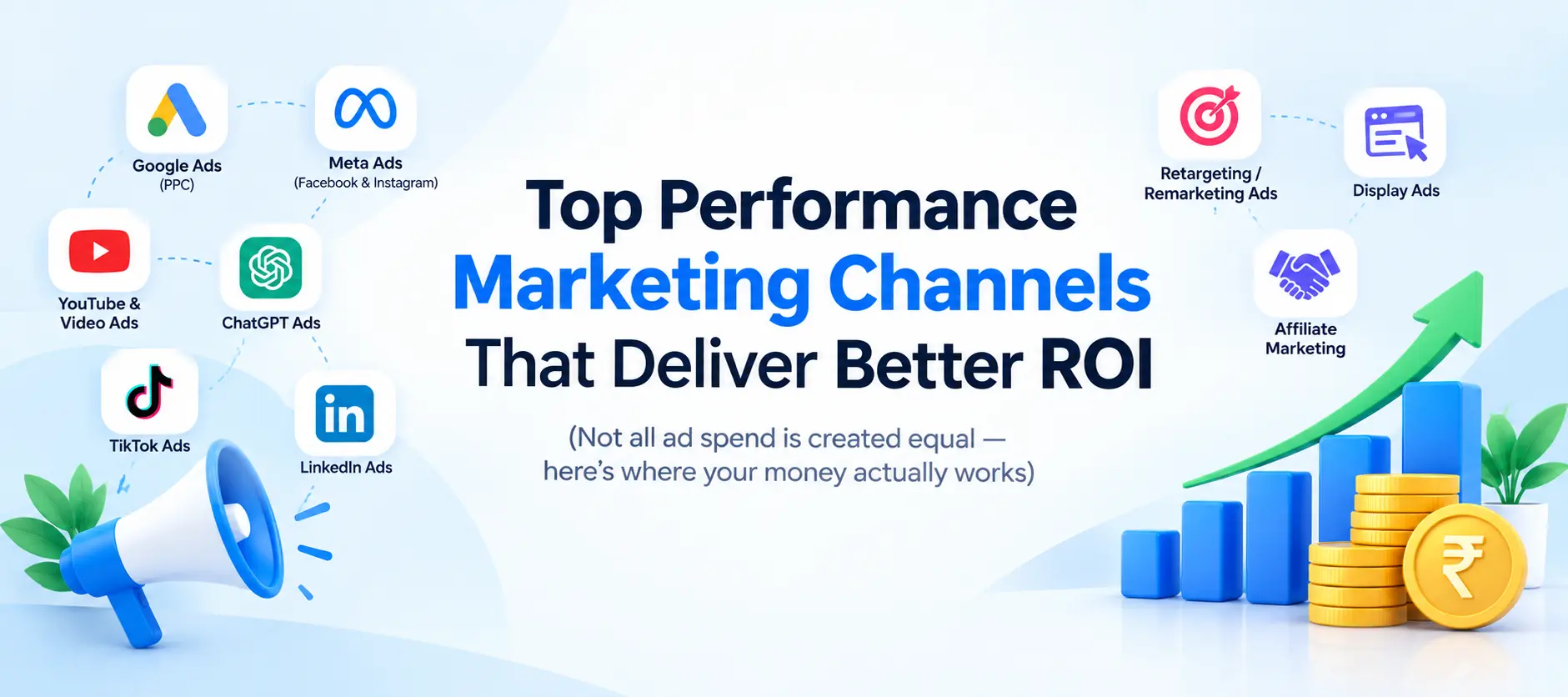
If performance marketing is all about “pay for results,” the obvious next question is: which channels actually deliver those results?
Because here’s the truth nobody likes to admit — throw money at the wrong channel, and you’ll get clicks, impressions, maybe even a vanity metric or two.
But ROI? That only shows up when the right channel meets the right audience with the right offer.
Let’s break down the channels that consistently earn their keep — and how to know which one is right for you.
Quick Refresher: What Makes a Channel “Performance Marketing”?
Before the list — one filter. A channel qualifies as performance marketing when you can draw a straight line from spend → action → result. If you can’t measure it, you can’t optimize it, and if you can’t optimize it, it’s not performance marketing — it’s a guess with a budget.
Keep that filter in mind as we go.
The 7 Channels Worth Your Budget
1. Google Search Ads (PPC)
What it is: Ads that show up when someone actively searches for something on Google.
Why it delivers ROI: This is intent-based marketing at its purest. Someone typing “buy running shoes online” isn’t browsing — they’re ready to act. You’re not creating demand, you’re capturing it.
Example: A local dentist runs a search ad for “root canal treatment near me.” Every click costs money, but every click is someone actively looking for exactly that service right now. Conversion rates on high-intent search terms routinely beat almost every other channel.
Best for: Businesses with a clear product/service and customers who actively search for solutions (services, e-commerce, B2B).
2. Meta Ads (Facebook & Instagram)
What it is: Ads placed across Facebook and Instagram feeds, stories, and reels, targeted by demographics, interests, and behavior.
Why it delivers ROI: Meta’s targeting engine is exceptional at finding “lookalike” audiences — people who behave like your existing best customers. Combine that with retargeting, and you get some of the cheapest conversions in the game.
Example: A D2C skincare brand uploads its list of past buyers. Meta finds 2 million people with similar shopping behavior. The brand runs a “20% off first order” ad to that exact lookalike audience — and sees a noticeably lower cost-per-sale than broad, untargeted campaigns.
Best for: Visually appealing products, impulse-buy items, brands with existing customer data to build lookalikes from.
3. ChatGPT Ads
What it is: OpenAI recently launched advertising in India, giving marketers a new platform to reach potential customers and generate business through AI-powered conversations.
ChatGPT Ads appear as clearly labeled “Sponsored” cards below a ChatGPT response, visually separate from the answer itself. These ads are available to eligible users on the Free and Go plans when a conversation carries commercial intent.
For marketers, this creates a new opportunity to connect with potential customers while they are researching products, comparing services, or making purchase decisions.
Why it delivers ROI: This channel meets the customer inside their actual research, not after it. Someone asking ChatGPT to compare products or plan a trip is already working through a decision, so a sponsored placement lands at the exact moment of intent — without fighting ten blue links for attention. It’s still early, which means less competition and lower costs than it will have a year from now.
Example: A user asks ChatGPT for dinner-party recipe ideas. Below the recipe suggestions, a labeled sponsored card from a grocery delivery brand appears with matching ingredients and a same-day delivery link — turning a planning conversation into a trackable purchase path.
Best for: Brands willing to test an emerging channel early, especially those selling products people already research conversationally — travel, food, software, and services.
4. YouTube & Video Ads
What it is: Skippable or non-skippable video ads shown before, during, or alongside YouTube content.
Why it delivers ROI: Video builds trust faster than text or static images — you can show a product working instead of describing it. Combined with precise targeting, it becomes a performance channel, not just a branding one.
Example: A software company runs a 15-second demo ad targeting people who recently watched “how to” videos related to their industry. The ad directly links to a free trial sign-up page — with sign-up cost tracked to the exact video and audience segment.
Best for: Products that benefit from demonstration (software, gadgets, courses, home goods).
5. Affiliate Marketing
What it is: You partner with individuals or websites (affiliates) who promote your product and earn a commission only when they generate a sale or lead.
Why it delivers ROI: This is performance marketing in its truest form — you literally pay only for results. Zero sales, zero spend. No wasted budget on impressions or clicks that don’t convert.
Example: An online course creator partners with 50 niche bloggers. Each blogger gets a unique tracking link and earns 20% commission per sale. The creator’s marketing cost scales exactly with revenue — never ahead of it.
Best for: Digital products, subscription services, e-commerce brands with healthy margins to share.
6. Retargeting / Remarketing Ads
What it is: Ads shown specifically to people who already visited your website or app but didn’t convert.
Why it delivers ROI: These are the warmest leads you’ll ever advertise to — they already know your brand. Most shopping carts get abandoned, and retargeting exists purely to win back that lost revenue.
Example: Someone adds a jacket to their cart on an e-commerce site but leaves without buying. Over the next three days, they see an ad for that exact jacket, sometimes with a small discount nudge. Retargeted shoppers convert at a much higher rate than cold audiences.
Best for: Any e-commerce business, especially ones with a multi-step checkout process.
7. Amazon & Marketplace Ads
What it is: Sponsored product placements within Amazon (or Flipkart, Etsy, etc.) search results and product pages.
Why it delivers ROI: You’re advertising to people who already have their card out, actively shopping for that category. It’s arguably the highest purchase-intent environment in all of digital marketing.
Example: A kitchenware brand runs Sponsored Product ads on “non-stick frying pan” searches within Amazon. Because the shopper is already in buy-mode, cost-per-sale tends to be far lower than trying to drive that same shopper from social media to the site externally.
Best for: Any brand already selling on a marketplace platform.
8. Influencer Performance Partnerships
What it is: Instead of paying influencers a flat fee, you pay based on performance — using unique discount codes or affiliate links to track exactly what they sell.
Why it delivers ROI: You get the trust and reach of influencer marketing, but with the accountability of performance marketing. No more guessing whether that “collab” was worth it.
Example: A fitness brand gives 10 micro-influencers a unique 15%-off code. Instead of paying a flat sponsorship fee, the brand pays a commission only on sales tracked to each code — turning an unpredictable expense into a measurable one.
Best for: Lifestyle, fitness, beauty, and fashion brands with a story worth telling.
9. TikTok Advertising
What it is: Native, full-screen video ads in the TikTok feed — from Spark Ads that boost organic-style content to In-Feed Ads and TopView placements — targeted by interest, behavior, and content engagement.
Why it delivers ROI: TikTok’s algorithm rewards content that feels native over content that feels like an ad. Brands that lean into trends, sound, and short-form storytelling get discovered by audiences who weren’t searching for them yet — and the built-in shop integration means that discovery can convert into a sale without ever leaving the app.
Example: A skincare brand runs a Spark Ad boosting a creator’s genuine unboxing video, tagged directly to a shop product listing. Viewers can buy from the video itself, collapsing the usual gap between “I saw this” and “I bought this.”
Best for: Visually engaging or trend-friendly products, brands targeting younger or discovery-driven audiences, and anyone selling through in-app shopping.
Not Sure Which Marketing Channel Is Right for Your Business?
Every business has a different audience, budget, and growth goal. Our digital marketing experts can help you identify the right channels and build a performance-focused strategy.
Let’s Find the Right Marketing Channel for Your Business.
The ROI Cheat Sheet
| Channel | Best For | Why It Converts |
|---|---|---|
| Google Search Ads | High-intent buyers | Captures existing demand |
| Meta Ads | Visual, impulse-buy products | Precision targeting + lookalikes |
| ChatGPT Ads | Commercial-intent conversations | Meets buyers inside AI-assisted research |
| YouTube Ads | Products needing demonstration | Builds trust through video |
| Affiliate Marketing | Digital products, healthy margins | Pay only on actual sales |
| Retargeting | Any e-commerce brand | Re-engages warm, ready buyers |
| Marketplace Ads | Sellers on Amazon/Flipkart/Etsy | Highest purchase-intent moment |
| Influencer Partnerships | Lifestyle & visual brands | Trust + trackable performance |
| TikTok Ads | Trend-driven, younger audiences | Native discovery + in-app shopping |
How to Actually Choose (Without Wasting Budget)
Don’t pick a channel because it’s trendy. Pick it by answering this:
- Where does my customer already have buying intent?
(Search vs. social vs. marketplace)
- Can my product be understood in a single image, or does it need explaining?
(Static ad vs. video)
- Do I have existing customer data to build from?
(Lookalikes work only if you feed them something)
- Can I afford to test small before scaling?
Every channel above needs a testing budget before it becomes a scaling budget — ROI doesn’t show up on day one, it shows up after a few rounds of optimization.
| The real secret most people miss: the highest-ROI strategy usually isn’t one channel — it’s a sequence. Cold traffic from Meta or YouTube discovers you. Retargeting brings them back. Google Search or Marketplace ads catch them when they’re ready to buy. Affiliates and influencers extend your reach into audiences you’d never find on your own. |
Stop relying on guesswork. Build a data-driven performance marketing strategy that focuses on reaching the right audience, generating leads, and tracking results.
Get Your Performance Marketing Strategy Started Today.
Quick Recap
- A channel only counts as “performance marketing” if you can measure spend → action → result
- Google Search & Marketplace Ads win on intent
- Meta & YouTube win on targeting and storytelling
- Affiliate & influencer partnerships win on pure pay-for-performance accountability
- Retargeting wins on recovering revenue you already earned once
- The real ROI comes from combining channels into a journey, not betting everything on one
Pick your channel based on where your customer already is — not where the loudest marketing trend says you should be.