For startups and entrepreneurs, waiting for organic reach to build is a luxury most early-stage businesses simply don’t have. In the first year or two, sales and leads need to come in now — and that’s exactly where performance marketing has always earned its keep. What has changed dramatically over the last couple of years is how those campaigns get built, run, and optimized. Artificial intelligence is now embedded across every major advertising platform, and it’s reshaping performance marketing from a manual, team-heavy discipline into a faster, data-driven one.
The Old Way: Performance Marketing Before AI
Running a single ad campaign used to require a small production line of specialists working together:
- A creative content writer for ad copy and messaging
- A graphic designer for static ad images and banners
- A video editor for reels, stories, and video ad formats
- A data analyst to track performance, pull reports, and guide optimization
- A media buyer to manually set targeting, bids, and budgets on each platform
For an early-stage startup with a limited budget, this made performance marketing expensive and slow. Every creative variation had to be built by hand, every audience had to be configured manually, and every optimization decision depended on a person noticing a trend in the data — usually after the budget had already been spent.
What AI Has Changed
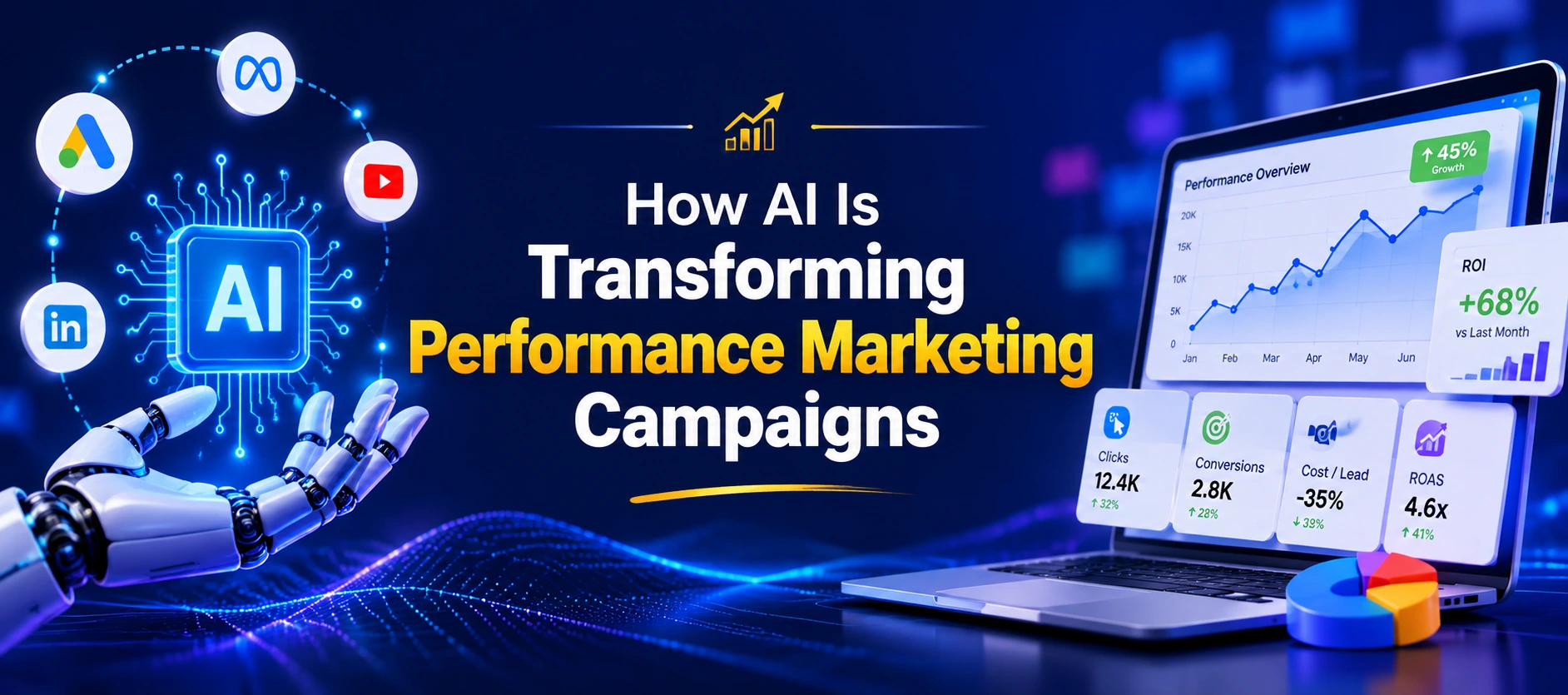
AI is now built directly into Google Ads, Meta Ads, LinkedIn Ads, and most other major platforms. Instead of replacing performance marketers, it has taken over the repetitive, high-volume parts of the job so the human team can focus on strategy, positioning, and offer. In practice, this shows up in three areas:
1. AI-Generated Creative
Ad copy, ad images, and even ad video can now be generated and tested automatically. Platforms can produce dozens of headline, image, and video variations from a handful of inputs, then let performance data — not guesswork — decide which combination wins.
2. Smarter Audience Targeting
AI systems analyze thousands of behavioral and contextual signals per user — far more than a human targeting setup ever could — to find the audience segments most likely to convert, and continuously refine that targeting as the campaign runs.
3. Lower Cost-Per-Lead, Higher Lead Quality
Because bidding, budget allocation, and targeting are optimized in real time rather than reviewed weekly, AI-managed campaigns are generally able to react to underperforming segments faster than a manual setup — which is where most of the CPL and lead-quality gains come from.
Real Cases: How Marketers Are Using AI on Meta, Google, and LinkedIn
Meta:
Advantage+ Campaigns
Meta’s Advantage+ system now sets the ad, audience, and budget automatically once a marketer supplies the goal, creative assets, and budget. According to Meta’s own reporting, Advantage+ Shopping campaigns have shown meaningfully lower cost-per-action and higher return on ad spend compared to manually built campaigns, and the format now accounts for a large share of e-commerce spend on the platform.
Meta Advantage+ Shopping — reported performance
| Cost per action (CPA) | Up to ~12% lower |
| Return on ad spend (ROAS) | Up to ~15–22% higher |
| Creative combinations tested per campaign | Up to 150 |
The trade-off marketers report: Advantage+ performs best when it’s fed clean pixel data, strong creative assets, and enough weekly conversions to learn from. Marketers who skip that groundwork and expect the AI to compensate for weak tracking or thin creative tend to see disappointing results.
Google:
Performance Max and AI Max for Search
Google’s AI-driven formats — Performance Max and the newer AI Max for Search — combine Search, Shopping, Display, and audience signals into a single automated campaign. Project management platform ClickUp is one documented example: after testing AI Max for Search on a small campaign, the team scaled the approach to more than 400 campaigns to grow leads and customer acquisition while holding ROAS steady.
It’s worth being balanced here: independent audits (from agencies such as Brainlabs, Monks, and Optmyzr, among others) have found mixed results outside of Google’s own case studies — some accounts see genuinely new demand and lower cost-per-click, while others see traffic cannibalized from existing campaigns or a rise in cost-per-lead when conversion tracking isn’t set up well. The consistent lesson across both the wins and the disappointments is the same: AI Max and Performance Max reward businesses with solid conversion tracking (ideally offline conversion imports for lead-gen) and punish accounts that don’t have it.
Google AI Max / Performance Max — what the data shows
| Best fit | Strong conversion tracking, clean product feed |
| Common startup risk | Weak tracking → inflated cost-per-lead |
| ClickUp case study outcome | Scaled from 1 test campaign to 400+ |
LinkedIn:
Accelerate Campaigns
LinkedIn’s Accelerate uses AI to build the audience, select top-performing creative, set bids, and manage placement across LinkedIn’s feed, messaging, and audience network — all from a handful of starting inputs. This matters most for B2B startups, where LinkedIn is often the highest-intent advertising channel available.
LinkedIn Accelerate — reported results
| Cost per action vs. classic campaigns | Up to 42% lower |
| Campaign build time | ~15% faster to set up |
| Calendly (via agency Closed Loop) | 3x higher lead-form completion, ~66% cheaper cost per lead |
For early-stage B2B companies without a dedicated media-buying team, this is one of the more accessible ways to run a credible LinkedIn lead-gen program without the steep learning curve Classic campaigns require.
What This Means for Startups and Entrepreneurs
AI hasn’t removed the need for strategy — if anything, it has raised the bar on inputs. The businesses seeing the strongest results share a few habits:
- Clean, accurate conversion tracking on every platform before scaling spend
- Feeding the algorithm strong creative and clear goals, then letting it test at scale
- Treating AI recommendations as a starting point to validate with real budget, not a rule to follow blindly
- Keeping a human in the loop for offer, messaging, and brand judgment — the parts AI still can’t do well
Day by day, these systems are getting more capable. For a startup that can’t afford to wait months for organic traction, that’s good news: it means a lean team — sometimes even one person — can now run campaigns across Google, Meta, and LinkedIn that would have required a full in-house team just a few years ago.
Need help turning AI-powered ad platforms into predictable leads and sales for your startup?
Our team manages Google Ads, Meta Ads, and LinkedIn Ads campaigns end-to-end from tracking setup to creative to ongoing optimization. Get in touch with us today to talk through your goals and build a performance marketing plan that fits your stage and budget.