
I’ve Watched Digital Marketing Change Before. This Time Feels Different.
When I started out in digital marketing more than 15 years ago, getting a business discovered meant one thing: getting it found on a search engine. You picked the right keywords, you built the right backlinks, you fought for that coveted first page, and if you got it right, customers came.
Today, I’m watching something else entirely. People aren’t just searching anymore, they’re asking. They’re opening ChatGPT and having a conversation, the way they’d ask a well-informed friend for a recommendation. And this week, that conversation started carrying ads in India.
“My first reaction wasn’t excitement. It was a quieter question: are we actually ready for this?”
ChatGPT Ads have landed in India
OpenAI has begun showing ads to ChatGPT’s Free and Go tier users in India, one of its largest and most active markets, with a self-serve Ads Manager opening to businesses on September 4. Early reports point to more than 50 brands participating in the initial rollout, working alongside agencies like WPP and Omnicom, with campaigns startable on daily budgets as low as roughly ₹725. Paid users on Plus, Pro, Business, Enterprise, and Education plans stay ad-free, and OpenAI has said ads will be clearly labelled, kept separate from ChatGPT’s actual answers, and kept away from sensitive territory like health and politics.
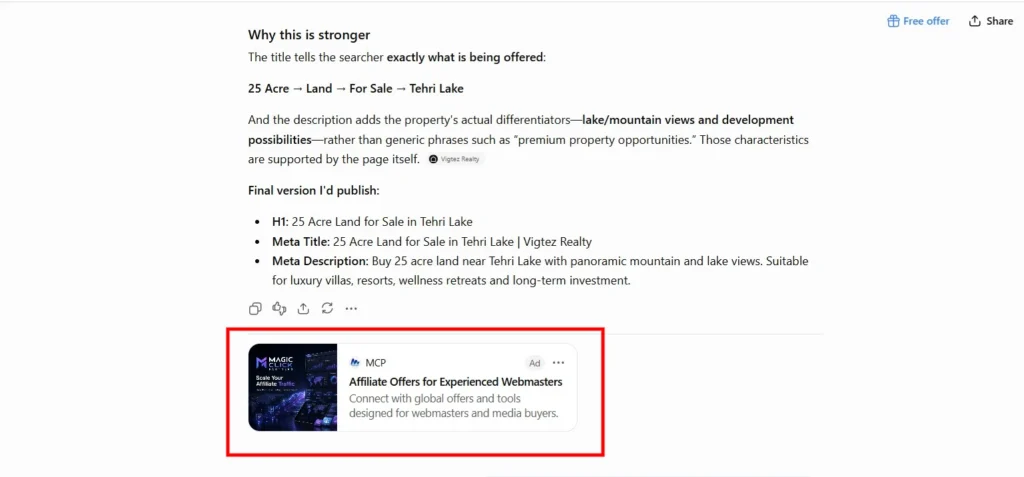
That last point matters. OpenAI is drawing a hard line that advertising should never shape what the AI actually tells you. Whether that line holds as the ad business scales is something every marketer watching this space should keep asking. But for now, the intent is on record, and the rollout is real, not a pilot.
I remember when Google changed the game
I’ve lived through more than one of these shifts. Keywords gave way to SEO. SEO gave way to Google Ads. Then social media arrived and reshaped how brands showed up in people’s lives. Content marketing taught us that value earns attention faster than interruption. Performance marketing made everything measurable down to the rupee. Influencer marketing taught us that trust travels through people, not platforms.
Each time, there was a wave of panic, a wave of over-correction, and eventually, a new normal that the smartest marketers had already quietly built for. I think we’re standing at the start of another one of those waves.
From “searching” to “asking”
Here’s the shift that actually matters, underneath all the headlines.
For twenty years, the default consumer behaviour was: I need something, let me search for it. You’d type a query, scan ten blue links, compare a few tabs, and decide.
Increasingly, the default is becoming: I need something, let me ask AI what I should choose. No ten links. No tab-hopping. One conversation, and often, one answer.
That changes everything about discovery, comparison, and decision-making. When a person searches, they’re doing the comparison. When a person asks, the AI is doing a lot of that comparing for them, and whatever it surfaces, or doesn’t, quietly decides who even gets considered.
Advertising inside a conversation
This is the part I find genuinely fascinating to sit with.
Traditional digital advertising interrupts. A user is scrolling, searching, watching, and an ad shows up competing for their attention. Conversational advertising is different in shape, that is why businesses must adopt SEO and advanced GEO to beat the competition in the AI era. The user is already mid-conversation, already stating an intent in their own words, already leaning in rather than scrolling past. A brand isn’t competing for attention anymore. It’s competing for relevance, inside a moment the user themselves created.
That’s a meaningfully different battlefield. Attention can be bought. Relevance has to be earned.
Want to get your business advertised on ChatGPT?
But here’s what worries me
I’ll be honest about the part that concerns me.
Every time a new ad platform arrives, a chunk of the industry brings the same old instinct with it: spend more, win more. I watched this happen with Google Ads. I watched it happen on social media. And I can already sense marketers getting ready to treat ChatGPT Ads the same way, as one more placement to throw a budget at.
I don’t think that instinct will work here the way it used to. In a conversational, AI-mediated environment, more money won’t automatically buy more influence. What will matter more is credibility, useful content, strong positioning, real first-party expertise, genuine reviews, clear product information, and consistent brand signals across the internet, the things an AI system actually draws on when it forms an answer. You can’t outspend an AI’s judgment of what’s genuinely useful the way you could once outbid a competitor for a keyword.
Does this mean SEO is dead?
No. And I’d push back hard on anyone saying otherwise.
SEO isn’t dying, it’s evolving. The question used to be simple: how do I rank on Google? The question now is bigger: how do I make my brand discoverable, understandable, and trustworthy across search engines and AI systems alike?
That’s a broader craft than classic SEO, call it AI search visibility, answer-engine optimisation, or brand-entity strength, whatever label ends up sticking. The mechanics are new. The underlying goal, being the trustworthy, well-structured, genuinely useful source that a system chooses to surface, is exactly the goal good marketers have always chased. We’re not throwing out the fundamentals. We’re applying them to a new surface. And for this, SEOs have to think differently on how we can get businesses featured inside ChatGPT & AI answers so as to im[prove business visibility, get more footfall and enhance overall revenue.
The biggest shift isn’t advertising. It’s a discovery.
For years, marketers learned how to get people to find their websites. Now we have to learn how to become the answer people are given.
That’s a bigger mental shift than it sounds like. It’s not about a new ad unit. It’s about your brand’s information, your positioning, your proof points, your reputation, being legible and trustworthy enough that an AI system chooses to hand it to someone as the answer, in a moment where that person isn’t even browsing anymore.
What should marketers actually do right now?
I’d resist the urge to react with either panic or a blank cheque. My honest, experience-led take:
- Don’t panic, this isn’t the end of everything that worked before.
- Don’t blindly spend just because a new platform exists.
- Start experimenting, in small, controlled ways.
- Strengthen your brand’s overall digital footprint, not just one channel.
- Create genuinely useful content, the kind an AI would actually want to cite.
- Learn how AI systems discover and represent brands today.
- Measure conversations and real business outcomes, not just clicks.
Should you start experimenting with ChatGPT Ads?
It depends on where you’re starting from. If your brand already has a strong, well-structured digital footprint, clear positioning, real reviews, solid content, I’d say experiment early, with a modest, controlled budget, and learn while the platform itself is still new and evolving. If your fundamentals aren’t there yet, I’d fix those first. A new ad platform won’t rescue a weak or unclear brand story; if anything, it exposes it faster.
What 15+ years in this field has taught me
Every major shift in digital marketing has looked like a threat to whatever came before it, in the moment it arrived. Search felt like it would kill traditional advertising. Social felt like it would kill SEO. Performance marketing felt like it would kill brand marketing. None of that happened cleanly, though, every aspect of marketing is growing day by day with the introduction of AI, whether it is AI in SEO, AI in social media or AI in performance marketing. What actually happened is that marketers who adapted didn’t throw away what they knew, they learned to apply their fundamentals to the new environment in front of them.
I expect the same thing here.
The next battle is for relevance
I don’t think search is dying. I think discovery is evolving, again.
The brands that win in this next phase probably won’t be the ones shouting the loudest or spending the most. They’ll be the ones that have quietly earned the right to be part of the conversation, long before anyone asked an AI to recommend them.
If you were leading marketing for a brand today, would you start experimenting with ChatGPT Ads, or wait and watch first? I’d genuinely like to know where you land.
If you want to know more about ChatGPT ads promotion and business boost up, get in touch below.