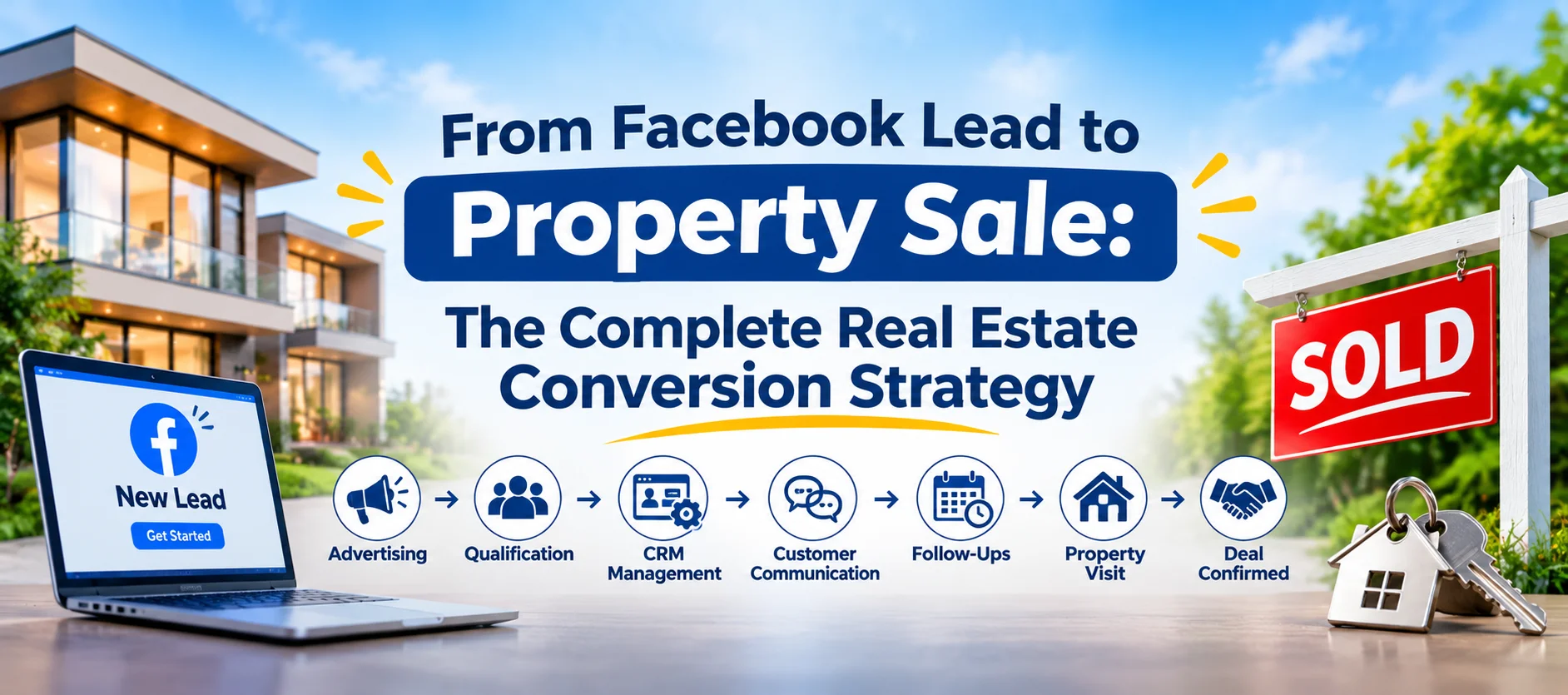
How real estate businesses can turn Facebook and Instagram enquiries into qualified buyers, property visits, and confirmed sales through smart advertising, CRM, and automated follow-ups.
Generating property enquiries through Facebook and Instagram Ads is easier than ever. But converting those enquiries into actual property sales remains a major challenge for many real estate businesses.
You might be receiving dozens of enquiries every week, but how many people are genuinely interested in buying a property?
How many respond when your sales team calls?
How many schedule a property visit? And most importantly, how many eventually purchase?
The problem is not always the quality of your advertising leads. Sometimes, the real problem starts after someone submits an enquiry.
A delayed response, an unorganized sales process, missed follow-ups, incomplete customer information, or a lack of communication can turn a potential buyer into a lost opportunity.
For real estate businesses, successful lead generation requires more than running Facebook or Instagram campaigns. It requires a complete system that connects advertising, lead qualification, customer communication, CRM, and consistent follow-ups.
In this guide, we will explain how to build a complete real estate lead conversion strategy and move prospects from their first Facebook enquiry to a confirmed property deal.
1. Why Generating Real Estate Leads Is Not Enough
Imagine you run a real estate agency and launch a Facebook advertising campaign to promote residential properties.
Within a few days, you receive 50 enquiries.
Initially, everything looks promising. Your advertising campaign is generating leads, and people are showing interest in your properties.
But then you discover:
- Some people are not genuinely interested in purchasing.
- Some enquiries have incorrect or incomplete contact details.
- Your sales team cannot contact every lead on time.
- Some potential buyers are interested but need more information.
- Follow-up calls are missed because customer details are scattered.
- Your team does not know which prospects are ready to schedule a property visit.
- Interested buyers eventually stop responding.
This creates a major gap between lead generation and actual sales.
The important question is not how many leads your Facebook Ads generate. It is how effectively your business manages those leads and converts them into customers.
A successful real estate marketing strategy should measure the entire customer journey, not just the number of form submissions.
Read >> Getting Real Estate Leads but No Sales? Here’s How to Fix Your Entire Growth System
2. Build a Targeted Facebook Lead Generation Strategy
The first step is attracting the right audience.
Facebook and Instagram Ads can help real estate businesses reach potential property buyers, investors, and people interested in specific locations or property categories.
However, launching an advertisement and expecting quality enquiries without proper planning is not an effective strategy.
You need to understand your target customers before creating your campaigns.
Understand your ideal property buyers
Start by identifying:
- Target location and service areas.
- Residential or commercial property requirements.
- Property price range.
- First-time homebuyers or experienced investors.
- Preferred property type.
- Potential buying timeline.
- Specific customer needs and interests.
For example, if you are promoting residential properties in a particular Canadian city, your campaign should be planned around the relevant location, property category, buyer profile, and advertising objectives.
The more clearly you understand your potential buyers, the easier it becomes to develop relevant advertising messages.
Create property-focused advertising creatives
Your advertisement should immediately communicate why someone should consider the property or contact your real estate business.
Consider including:
- High-quality property photographs.
- Short property walkthrough videos.
- Location advantages.
- Property features and amenities.
- Starting price or price range, where appropriate.
- Clear information about the next step.
Instead of using generic advertising messages, focus on the benefits that matter to your potential buyers.
For example:
Generic message: Looking for a new home? Contact us today!
More relevant message: Explore Modern Family Homes in Your Preferred Location. Get Property Details and Schedule a Viewing.
The second message gives potential customers a clearer reason to enquire.
Choose the right Facebook Lead Generation objective
Meta provides different lead generation options, including Instant Forms and website-based lead forms.
With Instant Forms, users can submit their contact details without leaving Facebook or Instagram.
Website forms allow businesses to direct interested users to a dedicated landing page where they can explore property information before submitting an enquiry.
The right option depends on your campaign objectives, customer journey, and lead qualification requirements.
For better lead quality, consider using a higher-intent form and asking relevant questions rather than collecting only names and phone numbers.
3. How to Qualify Real Estate Leads Before Sales Follow-Up
Not every person who submits a Facebook lead form is ready to purchase a property.
Some people are actively searching for a home, while others are exploring investment opportunities or simply researching available properties.
This is why lead qualification is an important part of real estate lead management.
Ask the right questions
Your Facebook lead form or initial conversation can help you understand the prospect’s requirements.
Consider asking:
- What type of property are you looking for?
- Which location do you prefer?
- What is your approximate budget?
- Are you planning to purchase immediately or within the next few months?
- Would you like to schedule a property visit?
Avoid making your forms unnecessarily long. Ask only the questions that help your sales team understand the customer’s requirements.
Categorize leads based on their interest
Once a lead enters your system, categorize it according to its current status.
| Lead category | Description | Recommended action |
| Hot Lead | Ready to purchase and actively searching | Immediate personal follow-up |
| Warm Lead | Interested but needs more information | Share relevant property details and schedule follow-up |
| Cold Lead | Exploring options without an immediate buying plan | Long-term nurturing |
| Unqualified Lead | Does not match the property or target requirements | Review and record the reason |
This approach helps sales teams prioritize their time and focus on prospects with a stronger likelihood of moving forward.
Remember, a lead’s status can change. A cold prospect today may become a serious buyer next month.
4. Respond Quickly and Start Meaningful Customer Conversations
Once someone submits an enquiry, the next step is communication.
This is where many real estate businesses lose potential customers.
A prospect who has just enquired about a property may also be contacting other agents and developers. If your team takes too long to respond, the opportunity to start a meaningful conversation may be lost.
Establish a clear lead response process
Whenever a new Facebook lead arrives:
- Capture the contact details automatically.
- Notify the responsible sales representative.
- Assign the lead to the appropriate team member.
- Initiate a timely call or permitted message.
- Understand the customer’s property requirements.
- Record the conversation details.
- Schedule the next action.
The objective is not simply to send an automated greeting. It is to start a relevant conversation and understand what the customer actually needs.
Use WhatsApp for customer communication
WhatsApp can be a useful communication channel for real estate businesses.
Customers may prefer receiving:
- Property photographs and videos.
- Location information.
- Price details.
- Brochures and property specifications.
- Available viewing schedules.
- Answers to common questions.
However, communication should be relevant and personalized. Avoid repeatedly sending generic promotional messages.
Use WhatsApp Business tools or an approved integration, with appropriate customer consent and messaging permissions.
5. Manage Every Enquiry Through a Centralized Real Estate CRM
As your advertising campaigns grow, managing leads manually becomes increasingly difficult.
Imagine receiving 100 or 200 enquiries from different advertising campaigns, website forms, social media channels, and referrals.
If all customer information is stored in different spreadsheets or personal WhatsApp accounts, your business may struggle to maintain a clear picture of every opportunity.
This is where Real Estate CRM Software becomes valuable.
A CRM (Customer Relationship Management) system helps businesses organize customer information, track conversations, manage sales activities, and monitor the progress of each lead.
What should your real estate CRM manage?
A well-organized real estate CRM should include:
1. Lead Information
Store customer names, phone numbers, email addresses, preferred locations, property requirements, and lead sources.
2. Lead Source Tracking
Identify whether an enquiry came from Facebook Ads, Instagram Ads, Google Ads, organic search, the company website, or a referral.
3. Conversation History
Maintain relevant records of customer interactions so sales representatives can understand previous discussions.
4. Lead Status Management
Track the progress of each prospect through different sales stages.
5. Follow-Up Scheduling
Assign the next follow-up date and remind the responsible salesperson about upcoming activities.
6. Team Management
Assign enquiries to the appropriate sales representatives and monitor their activities.
7. Conversion Tracking
Record which leads progress to property visits, negotiations, bookings, and confirmed sales.
The biggest advantage is that your team can manage customer information and sales activities from one centralized platform.
6. Never Miss a Potential Buyer with Automated Follow-Ups
One of the biggest challenges in real estate sales is maintaining consistent communication.
A potential buyer may not purchase a property during the first conversation. They may need additional information, time to compare options, financial planning, or approval from family members.
If your team does not follow up, the prospect may eventually choose another property or agent.
This is why a structured follow-up strategy is essential.
Create a systematic follow-up schedule
For example, a real estate business could use the following workflow:
| Follow-up stage | Suggested activity |
| Immediately after enquiry | Send an enquiry acknowledgement |
| First contact | Understand property requirements |
| After initial conversation | Share suitable property details |
| Next scheduled date | Follow up on the customer’s interest |
| Before property visit | Send viewing confirmation |
| After property visit | Collect feedback and discuss next steps |
| During negotiation | Maintain relevant personal communication |
| After booking | Update the deal status and customer records |
These are suggested touchpoints, not a universal schedule. The actual timing should depend on the prospect’s preferences and buying journey.
Automate WhatsApp and email follow-ups
With CRM and automation integration, businesses can create workflows that trigger messages and reminders based on customer actions and lead status.
For example:
- A new lead enters the CRM and receives an acknowledgement.
- The sales representative receives a notification.
- If the customer requests property details, the team can send the relevant information.
- A follow-up task is scheduled automatically.
- A reminder is generated before a property viewing.
- After the viewing, the sales representative records feedback.
- If the customer needs additional time, another follow-up is scheduled.
Automation can reduce repetitive administrative work and help teams maintain consistency.
However, automated messages should always be relevant, properly timed, and compliant with applicable privacy and messaging regulations.
7. Use AI Automation to Improve Real Estate Lead Management
AI and automation are creating new opportunities for real estate businesses to manage customer enquiries more efficiently.
Instead of relying entirely on manual processes, businesses can introduce intelligent workflows to support their sales teams.
Here are some practical applications.
AI-assisted lead qualification
AI-supported systems can help organize enquiry information and identify prospects based on their stated requirements, budget, preferred location, and buying timeline.
This helps sales teams prioritize conversations.
Automated lead assignment
Incoming enquiries can be assigned to the appropriate sales representative based on location, property category, availability, or other business rules.
Automated customer communication
Approved automation workflows can acknowledge enquiries, share relevant information, and send scheduled follow-up messages.
Smart reminders and scheduling
CRM automation can create tasks and reminders for upcoming calls, customer meetings, and property visits.
Customer conversation history
A centralized record of customer conversations helps sales representatives understand previous discussions and continue communication with better context.
The objective of AI automation is not to replace real estate sales professionals. It is to help them spend less time on repetitive tasks and more time understanding customers, building relationships, and closing deals.
8. Track the Complete Journey from Facebook Lead to Confirmed Property Sale
A real estate business should never evaluate its marketing performance using only the number of Facebook leads generated.
You need to understand what happens after each enquiry.
Consider the following sales journey:
Facebook / Instagram Ads → New Lead → CRM Entry → Customer Conversation → Lead Qualification → Follow-Up → Property Visit → Negotiation → Deal Confirmed
Every stage should have a clear status and responsible team member.
For example:
| Sales stage | What to measure |
| New Lead | Total enquiries received |
| Contacted | Leads successfully contacted |
| Qualified | Prospects matching your requirements |
| Interested | Prospects showing genuine purchase interest |
| Site Visit Scheduled | Confirmed property viewing appointments |
| Site Visit Completed | Actual property visits |
| Negotiation | Prospects discussing purchase terms |
| Deal Confirmed | Successful property sales |
This information helps business owners identify where opportunities are being lost.
For example, if your campaign generates a good number of leads but very few property visits are scheduled, you may need to improve lead qualification, initial communication, or the property offer.
If many property visits happen but few deals close, you may need to review pricing, property suitability, sales conversations, or the negotiation process.
The goal is to identify the actual bottleneck rather than automatically increasing advertising expenditure.
9. Real Estate Marketing Case Study: 119 Leads and 12 Homes Sold in Two Months
At Thrusture, we understand that every real estate business has different marketing requirements, customer profiles, and budget limitations.
In one of our Canadian real estate projects, an experienced real estate professional approached us with a specific business challenge.
The client had more than 15 years of experience in the real estate industry but had been facing difficulties over the previous two years.
Lead volume had declined compared with previous years, and the enquiries received were not converting into sales as expected.
The client wanted better-quality leads but had a limited marketing budget.
Understanding the client’s challenge
During our initial discussion, we identified the following requirements:
- Improve the volume of relevant property enquiries.
- Attract more serious potential buyers.
- Work within a limited marketing budget.
- Avoid unnecessary marketing expenditure.
- Develop a practical advertising strategy.
The client also expressed concern that Facebook and Instagram Ads might generate less-qualified leads compared with Google Ads.
Developing the right advertising strategy
We explained that Meta Ads and Google Ads serve different purposes.
Google Search Ads can help reach people actively searching for specific properties or real estate services.
Facebook and Instagram Ads can help introduce relevant property opportunities to potential buyers who may not be actively searching at that moment.
However, lead quality depends on the complete campaign strategy, including audience selection, creative messaging, property positioning, qualification questions, and follow-up.
After understanding the client’s requirements, we conducted approximately one week of research and campaign preparation.
We focused on the target audience, campaign positioning, advertising creatives, and lead generation strategy before launching the campaign.
The results
Within two months of campaign activity, the reported results were:
- 119 leads generated.
- 12 homes sold at good prices, according to the client information shared with us.
The experience reinforced an important lesson: successful real estate marketing requires more than simply generating enquiries. Understanding the audience, developing the right strategy, and managing incoming opportunities are equally important.
Every real estate campaign is different, and these results should not be considered a guaranteed outcome for other businesses.
10. What Real Estate Businesses Should Measure Beyond Cost Per Lead
A low cost per lead does not automatically mean a successful marketing campaign.
For example, a campaign generating 100 inexpensive enquiries may perform worse commercially than a campaign generating 30 relevant prospects who actively schedule property visits.
Real estate business owners should monitor the following metrics:
Cost Per Lead (CPL): How much are you spending to generate each enquiry?
Cost Per Qualified Lead: How much are you spending to acquire a prospect who meets your business requirements?
Lead Contact Rate: What percentage of incoming leads are successfully contacted?
Lead-to-Appointment Rate: How many prospects schedule property visits or consultations?
Property Visit Rate: How many scheduled visits actually take place?
Lead-to-Sale Conversion Rate: What percentage of leads eventually become customers?
Customer Acquisition Cost (CAC): How much does it cost to acquire an actual customer?
These metrics provide a more complete understanding of your marketing and sales performance.
They also help you decide whether to improve your advertising campaigns, sales process, CRM setup, or follow-up strategy.
11. Build a Complete Real Estate Growth System with Thrusture
Generating qualified property enquiries, maintaining a professional digital presence, managing customer relationships, and improving sales conversions require a connected business strategy.
Thrusture helps real estate businesses build this complete growth ecosystem.
Our solutions cover the entire journey:
Brand Building: Establish a professional brand identity and build trust with potential buyers.
Website Design and Development: Create professional real estate websites and landing pages that showcase properties and encourage enquiries.
Digital Marketing: Improve online visibility through SEO, social media marketing, and content strategies.
Meta Ads and Google Ads: Develop targeted advertising campaigns to attract relevant property enquiries.
Lead Management and CRM: Organize incoming leads, customer details, conversation history, and sales activities in one platform.
WhatsApp and Email Integration: Improve customer communication and support structured follow-up processes.
AI and Workflow Automation: Automate repetitive tasks, schedule reminders, and support consistent customer engagement.
Conversion Tracking: Monitor the complete journey from the first enquiry to property visits, negotiations, and confirmed deals.
Our objective is to help real estate businesses connect marketing and sales operations instead of managing them as separate activities.
Conclusion: Turn Every Real Estate Enquiry into a Managed Sales Opportunity
Generating a Facebook lead is the beginning of a potential customer relationship, not the end of a marketing campaign.
Real estate businesses need a complete system that connects advertising, lead qualification, customer conversations, CRM, WhatsApp communication, automated follow-ups, and conversion tracking.
When these activities work together, businesses can improve visibility across their sales pipeline, reduce missed follow-ups, and make more informed marketing decisions.
Whether you are a real estate broker, property consultant, or growing real estate agency, investing in the right digital marketing and customer management infrastructure can make your business growth process more organized and measurable.
Looking to Generate More Qualified Real Estate Leads and Convert Them into Sales?
Thrusture helps real estate businesses build complete growth solutions, from brand building and website development to performance marketing, CRM, WhatsApp integration, and AI automation.
Let’s understand your business requirements and build a growth strategy that connects every enquiry to the next step in your sales journey.