Introduction:
You are investing in Facebook Ads, Google Ads, property portals, and digital marketing. Your team is receiving enquiries, your lead numbers are growing, and your marketing reports look promising.
But when you check the actual business results, the situation is different.
Buyers are not answering calls. Some say their budget is too low. Others are only exploring the market. Site visits are limited, and the final number of property bookings remains disappointing.
If this sounds familiar, you are not alone.
Many real estate business owners face the same challenge: generating leads is not the same as generating sales.
The problem may not be your advertising budget or even the number of leads you receive. It could be a gap between your marketing strategy, lead qualification, sales follow-up, property presentation, and conversion process.
Real estate is a high-value purchase. Buyers often compare multiple properties, evaluate financing options, discuss decisions with family members, and take time before committing.
That means your business needs more than a lead generation campaign. It needs a complete growth system that turns potential buyers into qualified prospects, site visits, and ultimately, property sales.
In this guide, we will explore how real estate agents, brokers, builders, and property developers can identify the reasons behind poor conversions and build a more effective real estate marketing and sales system.
1. Stop Measuring Success Only by the Number of Leads
One of the most common mistakes in real estate marketing is focusing entirely on cost per lead (CPL).
For example, imagine two real estate businesses running digital marketing campaigns.
| Performance Metric | Business A | Business B |
| Advertising spend | ₹50,000 | ₹50,000 |
| Leads generated | 250 | 100 |
| Cost per lead | ₹200 | ₹500 |
| Site visits | 10 | 25 |
| Property bookings | 1 | 5 |
| Cost per booking | ₹50,000 | ₹10,000 |
Illustrative example only; actual results depend on the market, property, and sales process.
Business A generates more leads at a lower cost, but Business B generates five times as many bookings.
Which business has the better marketing strategy?
Business B, because its marketing investment produces more sales.
This is why real estate lead generation should not be evaluated only by the number of enquiries or their cost.
You need to track the complete journey from the first enquiry to the final booking.
What should you measure?
- Cost per lead (CPL)
- Percentage of leads contacted
- Qualified lead percentage
- Cost per qualified lead
- Site visit booking rate
- Site visit attendance rate
- Booking conversion rate
- Customer acquisition cost
- Return on advertising spend, where revenue and costs can be reliably attributed
These metrics help you understand whether your marketing is attracting the right audience and whether your sales team is converting that audience into business.
Actionable tip: Before increasing your advertising budget, calculate how many leads become qualified prospects, how many qualified prospects attend site visits, and how many site visits result in bookings.
Your weakest conversion stage should be the first place you investigate.
2. Identify Why Your Real Estate Leads Are Not Converting
Before changing your campaigns, identify where potential customers are dropping out of your sales process.
There are several common reasons.
Poor lead quality
Your ads may be attracting people who are not ready or financially prepared to purchase your property.
For example, a luxury apartment campaign may generate enquiries from people whose budgets are far below the property’s price range.
Similarly, a commercial property campaign may attract residential buyers if the advertising message is unclear.
How to fix it:
- Clearly communicate the property type, location, and relevant price information.
- Target audiences according to the actual buyer profile.
- Use lead forms with relevant qualifying questions.
- Separate campaigns for different projects, property types, and buyer segments.
- Review actual sales feedback before deciding whether a lead source is performing well.
Do not automatically classify every lead that does not convert as a bad lead. Some prospects need more information or time before making a decision.
Slow follow-up
A potential buyer submits an enquiry, but your sales team calls several hours later—or the next day.
By that time, the prospect may have contacted other agents or moved on to another property.
Speed matters because buyers often enquire about multiple properties during the same research session. Research and industry guidance on real estate lead management consistently emphasize prompt responses and structured follow-up.
How to fix it:
- Send an immediate acknowledgement after an enquiry.
- Assign every new lead to a responsible salesperson.
- Aim to make the first call within five minutes whenever practical.
- Share relevant property information through the prospect’s preferred communication channel.
- Record every contact attempt and schedule the next follow-up.
The five-minute target is an operational goal, not a guarantee of conversion. The important thing is to eliminate unnecessary delays.
Inconsistent follow-up
One unanswered call does not necessarily mean the prospect is uninterested.
A buyer may be working, travelling, discussing financing, or waiting for a suitable time to speak.
If your team stops following up after one or two attempts, you may lose opportunities that could have converted later.
How to fix it:
Create a follow-up schedule using calls, WhatsApp messages, email, and useful property updates. Adjust the frequency according to the buyer’s interest and communication preferences.
Avoid sending the same generic sales message repeatedly. Each follow-up should provide a reason to continue the conversation.
Lack of trust
Property buyers are making significant financial decisions. They need confidence in the property, the developer, the documentation, and the person guiding them.
If your website lacks project details, your advertisements make unrealistic promises, or your team cannot answer basic questions, prospects may hesitate.
How to fix it:
- Present accurate property details and pricing information.
- Share genuine property photographs and walkthrough videos.
- Provide relevant project documentation and registration details where applicable.
- Showcase authentic customer testimonials and completed projects.
- Explain the next steps clearly before asking for a booking.
Trust is not built through advertisements alone. It must continue throughout the sales process.
3. Build a Real Estate Marketing Strategy Around Buyer Intent
Not every person interested in real estate is ready to buy today.
Some buyers are actively comparing available properties. Others are researching locations, evaluating investment opportunities, or planning to purchase several months from now.
Your real estate marketing strategy should account for these differences.
Google Ads for high-intent property enquiries
Google Search Ads can help you reach people actively searching for specific properties, locations, or property-related services.
Examples include:
- 3 BHK flats in [City]
- Residential plots for sale in [Location]
- Commercial office space in [Location]
- Luxury apartments in [City]
- Property investment opportunities in [Location]
These searches can indicate a stronger purchase intent than a general interest in real estate, although search intent alone does not guarantee that someone is ready to buy.
How to improve Google Ads performance:
- Create separate campaigns for different property categories and projects.
- Use specific keywords related to the property, location, and buyer requirement.
- Write ad copy that clearly communicates the property’s main advantages.
- Direct users to a relevant project landing page rather than a generic homepage.
- Review search terms and exclude irrelevant traffic.
- Track qualified leads, site visits, and bookings instead of only form submissions.
For example, someone searching for commercial office space should land on a page that explains available office sizes, location, pricing, facilities, and enquiry options.
A relevant landing page helps prospects understand the offer before contacting your team.
Meta Ads for property discovery and lead generation
Facebook and Instagram Ads can introduce your property to potential buyers who may not be actively searching on Google.
They are particularly useful for showcasing new projects, residential communities, investment opportunities, and property walkthroughs.
However, a lead form that generates a high volume of enquiries does not automatically generate high-quality buyers.
Ways to improve real estate Facebook Ads:
- Use property walkthrough videos and genuine project images.
- Test different advertising messages for different buyer segments.
- Clearly communicate the property category and important details.
- Test instant lead forms against click-to-WhatsApp campaigns where appropriate.
- Add relevant qualifying questions without making the form unnecessarily complicated.
- Retarget eligible website visitors and engaged audiences.
- Evaluate leads according to their actual progress through the sales funnel.
For instance, a campaign targeting home buyers may ask about their preferred location, budget range, property configuration, and expected purchase timeline.
For commercial properties, useful questions may include business requirements, office size, budget, and intended use.
Collect only the information you genuinely need and handle prospect data responsibly.
Real estate SEO for long-term growth
Paid advertising can help generate enquiries quickly, but your business should not depend entirely on advertising.
Real estate SEO helps your website appear when potential buyers search for properties, developers, and locations.
Useful SEO opportunities include:
- Property-specific landing pages
- Locality-based property pages
- Guides to buying property in your target city
- Residential and commercial property comparison articles
- Local market and property investment guides
- Frequently asked questions about the buying process
For example, instead of targeting only a broad term such as “flats for sale,” a property developer could create a useful page around “3 BHK flats in [Locality, City]” if that accurately describes its inventory.
This approach helps match your content to specific buyer needs.
Important: Use keywords naturally and create genuinely useful pages. Publishing multiple near-identical locality pages with little unique information is unlikely to build a strong long-term SEO strategy.
4. Fix Your Landing Page Before Spending More on Ads
Your advertisement may be generating interest, but what happens after someone clicks it?
If the landing page is slow, confusing, incomplete, or difficult to use on a mobile phone, potential buyers may leave without enquiring.
A good real estate landing page should answer the prospect’s most important questions quickly.
Essential elements of a high-converting property landing page
1. A clear headline
Tell visitors exactly what property you are offering and where it is located.
2. Important property details
Include relevant information such as configuration, location, available amenities, and pricing where appropriate.
3. High-quality visuals
Use genuine property photographs, walkthrough videos, floor plans, and location visuals that help buyers understand the offering.
4. Clear calls to action
Examples include:
- Book a Site Visit
- Request Project Details
- Check Availability
- Speak to a Property Consultant
5. A simple enquiry form
Ask for essential information only. Every additional field should have a clear purpose.
6. Trust signals
Display genuine testimonials, company information, relevant credentials, and applicable project registration details.
7. Mobile-friendly performance
Ensure the page loads quickly, the text is readable, and enquiry buttons work correctly on mobile devices.
How to find landing page problems
Use Google Analytics 4 to understand user behaviour, Google Search Console to assess organic search performance, and PageSpeed Insights to identify performance issues.
Also check whether enquiry forms submit correctly and whether your conversion tracking records genuine leads without duplication.
Do not assume that a high bounce rate alone means a page is failing. Evaluate the full user journey, including engagement, enquiries, and downstream sales results.
5. Create a Real Estate Sales Funnel That Converts Leads into Buyers
One of the biggest gaps in real estate businesses is the absence of a clearly defined sales funnel.
Marketing generates enquiries, but there is no consistent process for deciding which prospects need an immediate call, which require additional information, and which should receive long-term nurturing.
A structured real estate sales funnel helps your team manage these stages.
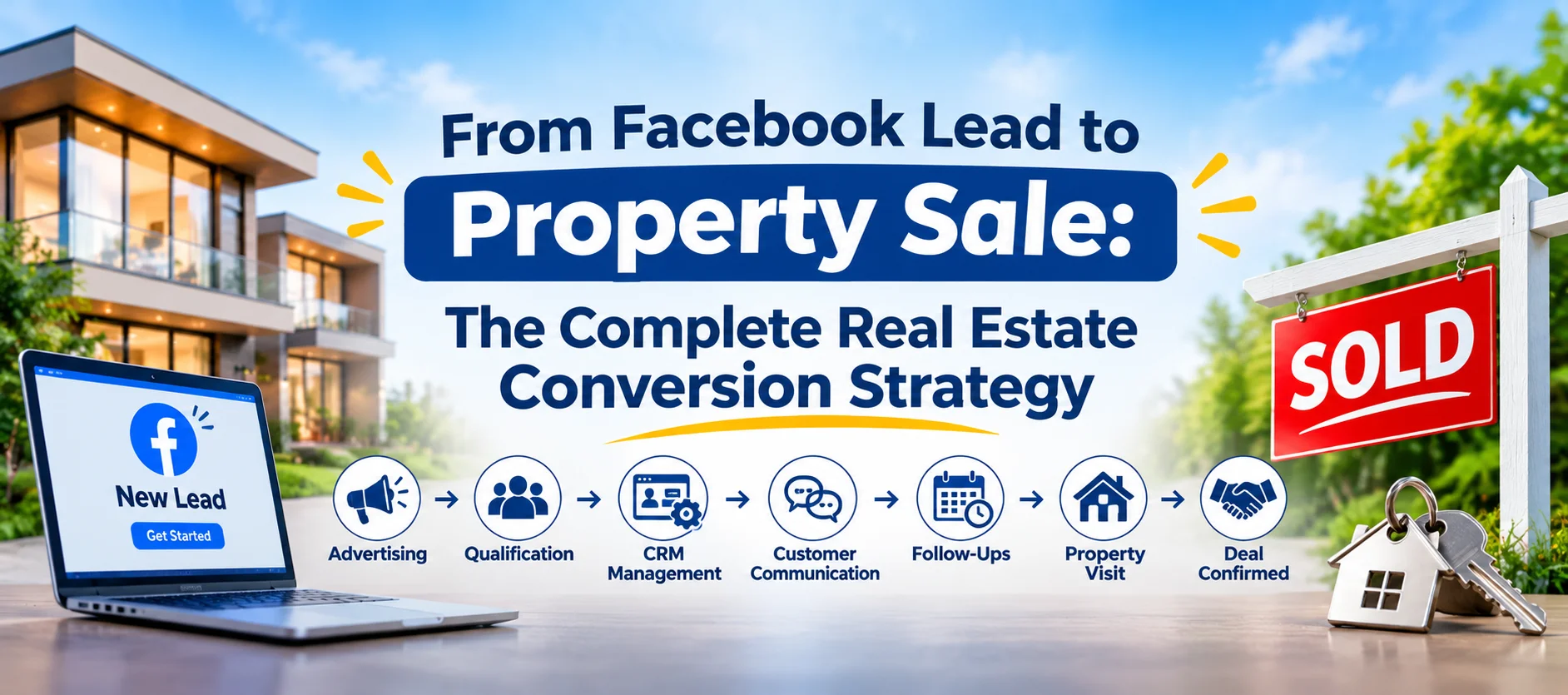
Awareness → Enquiry → Lead Qualification → Sales Conversation → Site Visit → Negotiation → Booking
Each stage needs a clear objective and a measurable outcome.
Stage 1: Enquiry
Capture leads from Google Ads, Meta Ads, your website, property portals, referrals, and other relevant sources.
Record the original source and campaign so you can evaluate performance later.
Stage 2: Lead qualification
Determine whether the prospect’s requirements align with the property.
Useful questions include:
- Which property type are you looking for?
- What is your approximate budget?
- Which location do you prefer?
- Are you buying for personal use or investment?
- When are you planning to purchase?
- Would you like to schedule a site visit?
Use these questions as a conversation, not an interrogation.
Stage 3: Sales conversation
Once you understand the buyer’s needs, explain how the property matches their requirements.
Instead of listing every feature, focus on relevant benefits such as location, connectivity, available amenities, property configuration, or investment considerations.
Be transparent about pricing, availability, and limitations.
Stage 4: Site visit
A site visit gives buyers an opportunity to evaluate the property in person.
Make the process convenient by offering suitable time slots, sharing directions, confirming appointments, and providing a clear contact person.
Send a reminder before the visit and follow up if the prospect cannot attend.
Stage 5: Negotiation and booking
After the visit, identify any remaining concerns.
The buyer may need clarification about pricing, financing, documentation, possession timelines, or comparisons with competing properties.
Your sales team should address these questions honestly and explain the next steps without creating artificial urgency.
The key principle: Every stage should move the buyer closer to an informed decision. If prospects repeatedly disappear at one stage, investigate that stage instead of automatically increasing the lead generation budget.
6. Use a Real Estate CRM to Manage Every Lead
If your team manages enquiries through spreadsheets, personal WhatsApp accounts, and disconnected call records, important opportunities can easily be missed.
A Customer Relationship Management (CRM) system creates a central record of leads, communication, follow-ups, and sales progress.
A suitable real estate CRM can help your team:
- Capture enquiries from different marketing channels.
- Assign leads to the right salesperson.
- Record call outcomes and buyer requirements.
- Schedule reminders and follow-up activities.
- Track site visits and booking status.
- Identify leads that have not received timely attention.
- Compare performance across campaigns and sales representatives.
You can evaluate platforms such as Zoho CRM, LeadSquared, or another system that fits your team’s size, integrations, and budget.
The best CRM is not necessarily the one with the most features. It is the one your team will use consistently.
A simple real estate lead management structure
| Lead Stage | Required Action |
| New enquiry | Assign the lead and make initial contact |
| Contacted | Record the conversation and requirements |
| Qualified | Confirm budget, location, and purchase timeline |
| Site visit planned | Schedule and confirm the appointment |
| Site visit completed | Record feedback and next steps |
| Negotiation | Resolve questions and discuss terms |
| Booked | Record the confirmed sale |
| Nurturing | Schedule relevant future follow-ups |
| Lost | Record the actual reason, where known |
This structure gives business owners visibility into what is happening after marketing generates an enquiry.
It also helps prevent the common problem of spending money on leads without knowing what ultimately happened to them.
Looking to Grow Your Real Estate Business?
Build a stronger digital presence and generate quality property leads with Thrusture’s integrated digital marketing solutions.
7. Build a Follow-Up System Instead of Depending on Salespeople’s Memory
Many property purchases take weeks or months of consideration. A buyer who is not ready today may become a serious prospect later.
However, long-term follow-up should not mean repeatedly asking, “Are you interested?”
Instead, provide information that helps buyers make decisions.
Example of a practical seven-day follow-up plan
Day 1: First contact
Call the prospect, understand their requirements, and share relevant property information.
Day 2: Helpful information
Send the requested brochure, price details, location information, or a suitable property walkthrough.
Day 3: Understand objections
If the buyer is not responding, try another appropriate contact method or ask when it would be convenient to speak.
Day 4: Share relevant options
If the original property does not meet the buyer’s requirements, suggest an alternative only when it is genuinely suitable.
Day 5: Offer a site visit
Explain what the buyer can evaluate during the visit and offer convenient appointment times.
Day 7: Review and plan the next step
Record the prospect’s interest level, outstanding questions, and preferred follow-up date.
This is a sample framework, not a rigid rule. Adapt it to the buyer’s behaviour, communication preferences, and applicable consent requirements.
For buyers with longer purchase timelines, continue nurturing them with relevant updates rather than treating every delayed decision as a lost opportunity.
8. Connect Your Marketing Data with Your Sales Results
Your advertising platforms can report leads, clicks, impressions, and costs. But these metrics alone do not tell you which campaigns generate actual business.
To make better decisions, connect your marketing data with your CRM and sales pipeline.
For example, imagine that Campaign A generates 100 leads and Campaign B generates 40 leads.
At first glance, Campaign A appears stronger.
However, after reviewing sales data, you discover:
- Campaign A generates 100 leads and 5 site visits.
- Campaign B generates 40 leads and 12 site visits.
Campaign B may be attracting more relevant prospects, even though it generates fewer enquiries.
You need additional data on bookings and revenue before declaring a final winner, but the site-visit figures already provide a useful signal.
What to track in your real estate marketing dashboard
| Metric | What It Helps You Understand |
| Cost per lead | How much you pay for an enquiry |
| Qualified lead rate | How well leads match your target buyer |
| Cost per qualified lead | The cost of acquiring a relevant prospect |
| Lead-to-site-visit rate | How effectively enquiries progress |
| Site-visit attendance rate | How reliably booked visits happen |
| Site-visit-to-booking rate | How effectively visits become sales |
| Cost per booking | Advertising cost associated with a booking |
| Revenue by campaign | The business value generated by each campaign |
Whenever possible, import meaningful offline conversion events into your advertising platforms, subject to the platform’s requirements and appropriate data permissions.
For example, qualified leads and confirmed bookings can provide more useful feedback than raw form submissions alone.
The goal is to optimize your marketing for business outcomes, not simply cheaper enquiries.
9. Improve Your Property Content to Build Trust Before the First Call
- Real estate buyers often research properties before contacting an agent or developer.
- Your content should answer their questions and help them understand why a property may be suitable.
- A collection of promotional posts alone may not be enough.
- Build a content strategy around the questions buyers actually ask.
Real estate content ideas that support lead generation
Property walkthrough videos
Show the actual property, layout, surroundings, and relevant features.
Location guides
Explain connectivity, transport, nearby facilities, and other verified local advantages.
Buying guides
Help first-time buyers understand the purchase process, financing considerations, and documentation.
Property comparison content
Explain meaningful differences between available configurations, locations, or property types.
Frequently asked questions
Answer common questions about pricing, amenities, possession timelines, maintenance, and site visits.
Customer testimonials
Share genuine feedback and case examples with permission.
Market updates
Discuss relevant local market developments using reliable data and clearly explain what they may mean for buyers.
These formats can support organic search, social media, retargeting campaigns, and sales conversations.
For SEO, create content around relevant keywords such as “property investment in [City],” “flats for sale in [Location],” or “how to buy a house in India” when these topics match your audience and services.
Avoid making unsupported claims about guaranteed appreciation, rental income, or investment returns.
10. Create a 30-Day Action Plan to Improve Real Estate Sales
You do not need to change your entire marketing operation overnight.
Start by identifying the biggest gap and improving the process in stages.
Week 1: Audit your current performance
- Review the previous 30–90 days of leads.
- Compare lead quality across Google Ads, Meta Ads, property portals, and organic channels.
- Calculate qualified lead, site-visit, and booking rates.
- Review call response times and follow-up records.
- Identify where the highest number of prospects drop out.
Goal: Understand where your current growth system is losing opportunities.
Week 2: Fix lead handling and qualification
- Establish a clear lead assignment process.
- Introduce a standard qualification framework.
- Set a response-time target.
- Create follow-up reminders and message templates.
- Organize your sales pipeline in a CRM or structured tracking system.
Goal: Ensure that new enquiries receive timely, consistent attention.
Week 3: Improve advertising and landing pages
- Separate campaigns according to property type and buyer intent.
- Review targeting, search terms, creatives, and lead forms.
- Improve the landing page’s clarity and mobile experience.
- Test relevant property videos and messaging.
- Check that conversion tracking works correctly.
Goal: Attract better-matched prospects and reduce avoidable friction.
Week 4: Measure results and optimize
- Compare qualified leads across campaigns.
- Review site visits and attendance.
- Identify the best-performing sources by downstream sales progress.
- Collect feedback from sales representatives.
- Adjust budgets based on evidence, not lead volume alone.
- Set targets for the next 30 days.
Goal: Build a repeatable process for improving lead quality and sales conversion.
At the end of 30 days, review whether the changes have improved contact rates, qualified enquiries, site visits, and bookings. Real estate sales cycles can extend beyond a month, so some improvements may require more time to show up in final revenue.
11. When Should You Scale Your Real Estate Marketing Budget?
Increasing your budget can help you reach more potential buyers, but scaling too early can increase wasted spending.
Before increasing advertising investment, make sure you can answer these questions:
- Do we know which campaigns generate qualified leads?
- Does our sales team follow up consistently?
- Are qualified prospects attending site visits?
- Do we understand the main reasons buyers do not proceed?
- Can we calculate our approximate cost per booking?
- Do we have enough sales capacity to handle additional enquiries?
If your campaigns generate many leads but very few qualified conversations, improve targeting and lead handling first.
If qualified prospects attend site visits but rarely book, investigate pricing, property-market fit, buyer objections, presentation, and the sales process.
If your funnel is working consistently and the cost of acquiring a customer is commercially viable, you can test higher budgets gradually while monitoring performance.
There is no universal advertising budget or conversion rate that works for every real estate business. A local broker, an affordable housing developer, and a luxury property brand will have different economics and buying cycles.
Your growth strategy should reflect your specific property, market, sales capacity, and business goals.
Conclusion: Build a Growth System, Not Just a Lead Generation Campaign
Getting real estate leads but no sales is a signal to investigate your entire customer journey.
More leads will not automatically solve problems caused by slow follow-ups, poor qualification, weak landing pages, unclear messaging, or an inconsistent sales process.
A stronger approach connects every part of the business:
- Targeted real estate lead generation
- Relevant Google Ads and Meta Ads campaigns
- Search engine optimization and useful property content
- Conversion-focused landing pages
- Timely lead qualification and follow-up
- CRM-based lead management
- Consistent site-visit coordination
- Sales tracking and performance optimization
When these elements work together, you gain better visibility into where opportunities come from, why they are lost, and what needs to improve.
The real goal is not to generate the maximum number of real estate leads. It is to build a predictable system that turns the right enquiries into qualified conversations, site visits, and profitable property sales.
Start by auditing your existing process. Find the biggest gap, fix it, and measure the result before moving to the next improvement.
That is how real estate businesses can move beyond chasing leads and build a more sustainable growth system.
Let’s Build Your Real Estate Growth System
From website development and brand building to SEO, paid advertising, and lead generation, Thrusture helps real estate businesses connect their marketing efforts with business growth.