What AI agents change about search, what the data shows, and why weak positioning has nowhere left to hide
For years, a mediocre SEO strategy could survive on momentum. A decent set of keywords, a steady stream of blog posts and a handful of backlinks were often enough to hold a page-one position, and page one was enough to bring in customers. Nobody had to ask hard questions about what the business actually stood for, because the system rewarded activity.
The reason that worked is that rankings, traffic and keyword positions were never the real goal. They were proxies for a harder question: is this business genuinely the best answer for this customer? Search engines could not answer that directly, so they estimated it with signals such as links, keywords and page count, and signals like these can be gamed. Agentic SEO changes the arrangement because AI agents are built to answer the underlying question, and they do it by cross-checking what a business says about itself against what everyone else says.
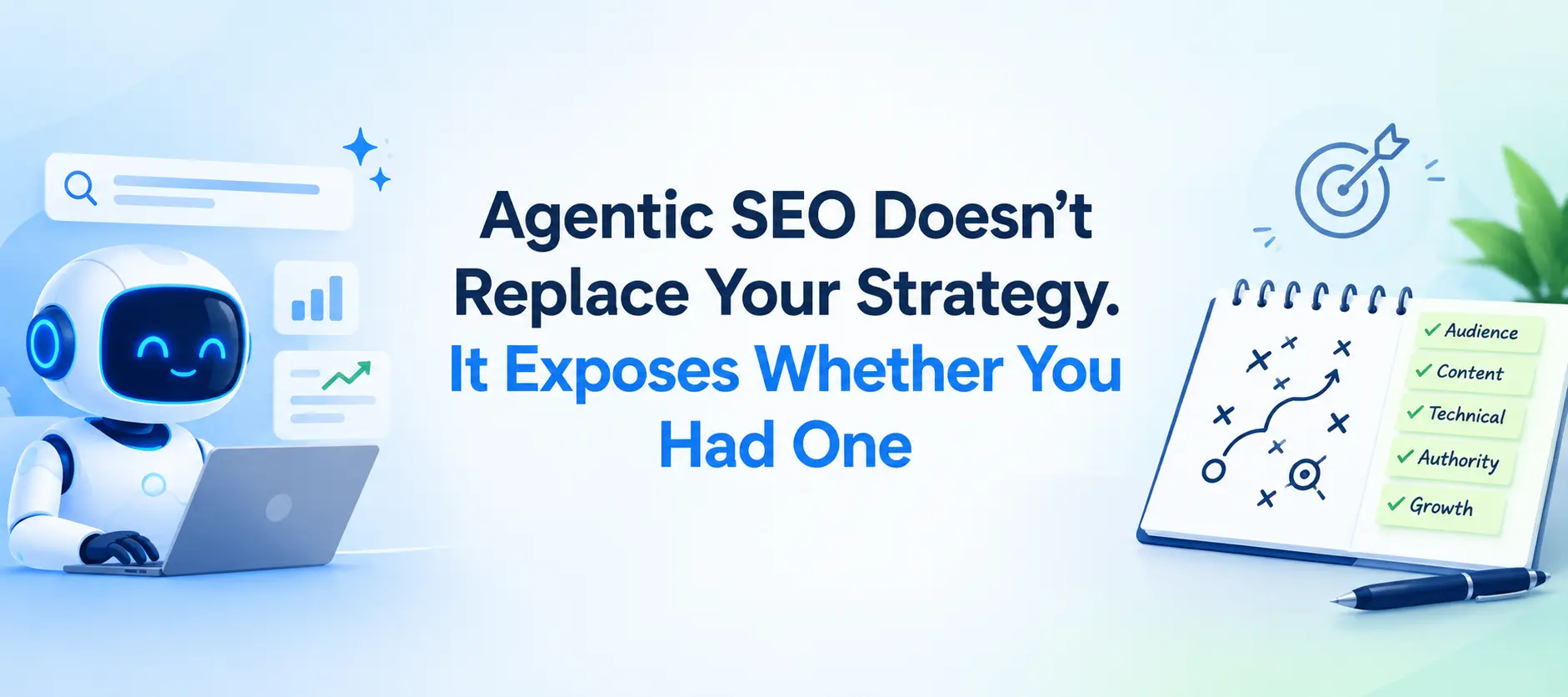
That is why agentic SEO does not replace your strategy. It audits it.
What Agentic SEO Actually Means
The searcher is no longer always a person
Traditional SEO assumed a human on the other end: someone who types a query, scans ten blue links and clicks the one that looks right. Agentic SEO deals with a different reality, in which an AI agent does that work first. It reads several sources, weighs them against what the user asked for, and returns a short list or a single recommendation. The person may never see the pages that were rejected.
From matching queries to making decisions
The deeper change is in the task itself. A traditional search engine matched a query to pages and left the judging to the human. An agent is handed a goal, such as finding a beginner-friendly option within a budget in a particular city. It breaks that goal into questions, gathers evidence and returns a judgement. Retrieval has become judgement, and judgement needs evidence. Much of that evidence does not live on your website.
What the Data Says About the Shift
Clicks are disappearing before agents even arrive
The groundwork was laid by AI summaries in search results. SparkToro’s 2026 study of US Google searches, covering January to April, found that about 68% ended without a click to any website. It also found that AI Overviews now appear on more than one in five searches, and that click-through rates fall by nearly 60% when one is present.
Other researchers point the same way. Pew Research Center’s browsing study found that users clicked a result in 8% of visits when an AI Overview appeared, compared with 15% when it did not. Ahrefs measured a 58% lower click-through rate for the top-ranking page when an AI Overview was present by December 2025, up from a 34.5% decline in April 2025. Different methods, same direction.
Ranking and being chosen are becoming different things
Seer Interactive’s study of 53 brands and 2.43 billion impressions found that pages cited inside an AI Overview earn more clicks than pages on the same results page that are not cited. Being named by the machine is now worth more than simply being listed. Yet one cross-study analysis reported that citations coming from top-ten ranking pages fell from 76% to 38% by March 2026. If that holds, a high ranking no longer guarantees a place in the answer.
The same Seer study found that nearly every informational “X vs Y” query it tracked, 95.4%, triggered an AI Overview. This matters more than it first appears. Comparison queries are the ones people type when they are close to choosing, so the searches nearest to a purchase decision are exactly where an AI layer now sits between the customer and your website.
The visitors who do arrive are worth more
Adobe Analytics reported that AI-referred traffic to US retail sites grew 393% year over year in the first quarter of 2026. The quality shift is more telling than the growth. In March 2025, that traffic converted 38% worse than other traffic. In March 2026, it converted 42% better. Shopify separately reported that AI-driven traffic to its merchants grew roughly eightfold in the same quarter, with orders from AI-powered searches up nearly thirteenfold.
People who arrive through an agent have usually already been advised. They are not browsing. They are close to a decision, so the brands that make the shortlist capture a disproportionate share of the value.
Keeping it in proportion
A fair reading also includes the limits. AI-driven sessions still make up well under 1% of total e-commerce traffic, and SparkToro found that only 0.34% of searches moved into Google’s AI Mode during its study period, even though Google says AI Mode has passed a billion monthly users and is growing fast. Most of these figures come from US datasets and different methodologies, so they show direction more than exact size. The trend is clear. The scale is still forming, which is why the businesses acting now have an advantage.
Where an Agent Forms Its Opinion of Your Brand
Your website is the claim. The rest of the web is the evidence.
This is the part most agentic SEO advice skips. When researchers look at what AI systems actually cite, the brand’s own website is usually the minority source. Muck Rack’s analysis of more than 25 million links cited by AI engines found that earned, third-party media accounted for about 84% of citations, a share that stayed between 82% and 89% across three editions of the study. Paid and advertorial content accounted for 0.3%.
Ahrefs found something consistent when it studied 75,000 brands. Branded web mentions correlated with visibility in AI Overviews at 0.664, while backlinks correlated at only 0.218. The three strongest signals it measured were all off-site. Ahrefs itself cautions that correlation is not causation, and it is one study, but the direction fits the citation data.
There is a useful nuance here. Yext’s large citation studies found that for objective, factual questions, brands’ own websites can supply a large share of the answer, over 40% of citations in one analysis. Third-party sources dominate when the user asks the agent to judge, rank, recommend or compare. In plain terms, your website is where the agent checks the facts, and the rest of the web is where it decides whether to believe them.
Why this makes it a strategy problem, not a technical one
You cannot optimise your way into being mentioned by independent sources. Mentions, reviews and comparisons happen when a business is distinctive, useful or reputable enough for other people to say something about it. A business with nothing distinctive to say gives the rest of the web nothing to repeat, and no amount of on-page polish fixes that.
It also puts technical fixes in perspective. Structured data helps a machine read a page, and it remains good practice, but one Ahrefs test reportedly found no significant change in AI citations after schema markup was added. Treat it as hygiene, not as the lever.
An Illustration: Two Businesses, Similar Rankings
Consider a hypothetical example. A traveller asks an AI agent to find a beginner-friendly yoga teacher training programme in Rishikesh within a stated budget, with dates in the next two months. Two schools rank close to each other for the obvious keywords.
The first school has a polished website and years of blog posts, but its pages describe the programme in general terms, its fees and dates are hard to find, and outside its own site there are few reviews and almost no independent mentions. The second school ranks slightly lower, but it states its curriculum, fees, teacher credentials and upcoming dates plainly. Its details match across its website, its directory listings and its profiles, and graduates have described their experience on independent platforms.
The agent has to justify its answer, and it can only justify what it can verify. It recommends the second school. Nothing about the first school’s SEO was technically wrong. What it lacked was a clear position that the rest of the web could confirm.
Before and After: How Search Changes When Agents Arrive
The table below summarises what actually moves when an agent sits between your customer and your website.
| Before AI agents | After AI agents | |
| Who searches | A person types a query and scans results | An agent searches, compares and shortlists on the person’s behalf |
| What success means | Ranking on page one | Being cited, recommended and chosen |
| How content is judged | Keywords, backlinks, page speed | Clarity, consistency and proof that can be verified elsewhere |
| Where authority comes from | Links pointing at your own site | What independent sources say about you, and how often |
| Clicks | Most searches ended in a click somewhere | Roughly two in three US Google searches end with no click |
| Visitor quality | Broad and mixed intent | Fewer visits, but from people already close to deciding |
| The website’s job | Attract and persuade a human visitor | State clear facts an agent can trust, then persuade the human |
| How you measure it | Rankings and sessions | Presence in AI answers, share of recommendation, branded demand |
| Cost of a weak strategy | Lower rankings, slower growth | Not being shortlisted at all |
Why Agents Expose Weak Strategy
Vague positioning has nothing to be verified against
A human skimming a page can forgive vague copy if the design is pleasant. An agent cannot. It looks for a plain answer to a plain question: what does this business do, who is it for, where does it operate and why should it be trusted? Websites built around keyword targets instead of a clear position tend to fail this test, because there is no clear position to find.
Inconsistency reads as risk
Agents cross-check. If your website describes one service, your directory listings describe another and your reviews mention a third, the picture that comes back is muddled, and a muddled brand is a risky one to recommend. Consistency across your site, profiles and mentions used to be a housekeeping task. It is now part of how machines decide whether you are real and reliable.
Commodity businesses get compressed
A useful way to see who is exposed is to sort businesses into three groups. The first sells much the same thing as its competitors and describes it in much the same words. Agents can summarise this group into a single sentence, and once they do, there is little reason to name any one member. The second is a specialist with a clear niche, a defined customer and specifics an agent can quote. The third is a recognised authority that others already mention when the topic comes up. Agentic search squeezes the first group hardest and rewards the other two. Which group you are in is a strategy decision, not an SEO setting.
What Changes in How You Measure Success
Rankings and sessions still matter, but they now tell only part of the story. A brand can be recommended in an AI answer, win the customer, and record nothing more than a branded search or a direct visit afterwards. This is why a report that looks only at referral links will typically understate AI’s commercial impact. Many citations also point to third-party pages rather than the brand’s own domain, so the value shows up somewhere else.
The measures worth adding are whether your brand appears in AI answers for the questions your customers ask, how it is described when it does, which sources the agent relies on, and whether branded demand is rising. Traffic becomes one indicator among several, and being recommended becomes the outcome to watch.
A Simple Test Before You Spend Anything
You can learn a great deal about your position in ten minutes. Ask the major AI tools the questions your customers would ask, using your category and location, and read the answers as a customer would. Notice whether you are named at all, how you are described, which sources are cited, and which competitor gets the credit you expected to receive.
The gap between how you would describe your business and how the agent describes it is your strategy gap. Sometimes it is a content problem. More often it is a positioning problem that content had been quietly covering up.
Where Businesses Will Go Wrong
The first mistake will be buying old tactics under a new label. Much of what is being sold as agentic SEO is traditional SEO with a fresh name, and a business that cannot say what makes it different will not be rescued by any of it. The second will be manufacturing mentions. Agents and the publications they trust are increasingly able to tell earned coverage from placed coverage, and credibility that was purchased tends to read that way. The third will be treating agentic SEO as a one-off project. Corroboration builds over time, and competitors that establish it early become harder to displace.
What a Real Strategy Looks Like Now
None of this makes traditional SEO obsolete. Technical health, quality content and authority still decide whether you are found at all. What has changed is what sits on top of them. A durable strategy starts with a sharp answer to a business question, not a marketing one: why should anyone, human or machine, choose you over the alternative? Content, structure, reputation and proof then exist to make that answer unmistakable wherever it is read.
How that is built in practice depends on your market, your competitors and the state of your current site and reputation, which is why a one-size-fits-all template rarely works.
The Bottom Line
Agentic SEO is not a threat to businesses with a real strategy. It is a stress test. It removes the cushion that let vague positioning and shallow content look like performance, and it shows plainly which brands are worth recommending. The businesses that answer the strategy question now will be shortlisted. The ones that keep waiting will find that the shortlist was written without them.
Not sure whether your SEO strategy would survive an AI agent?
Our team can review how your brand appears to search engines and AI agents, and show you where the gaps are. Contact Us to talk about agentic SEO, AI search optimization and a strategy built for the way customers now find businesses.