
Let me be honest with you.
I didn’t stumble into this. I didn’t get lucky. And I definitely didn’t follow the same recycled “optimize for AI” advice that’s been floating around LinkedIn for the past year.
I spent months testing, failing, rebuilding, and watching my competitors show up in Google’s AI Overview while my website sat there — perfectly indexed, technically clean, and completely ignored by AI.
Then something shifted.
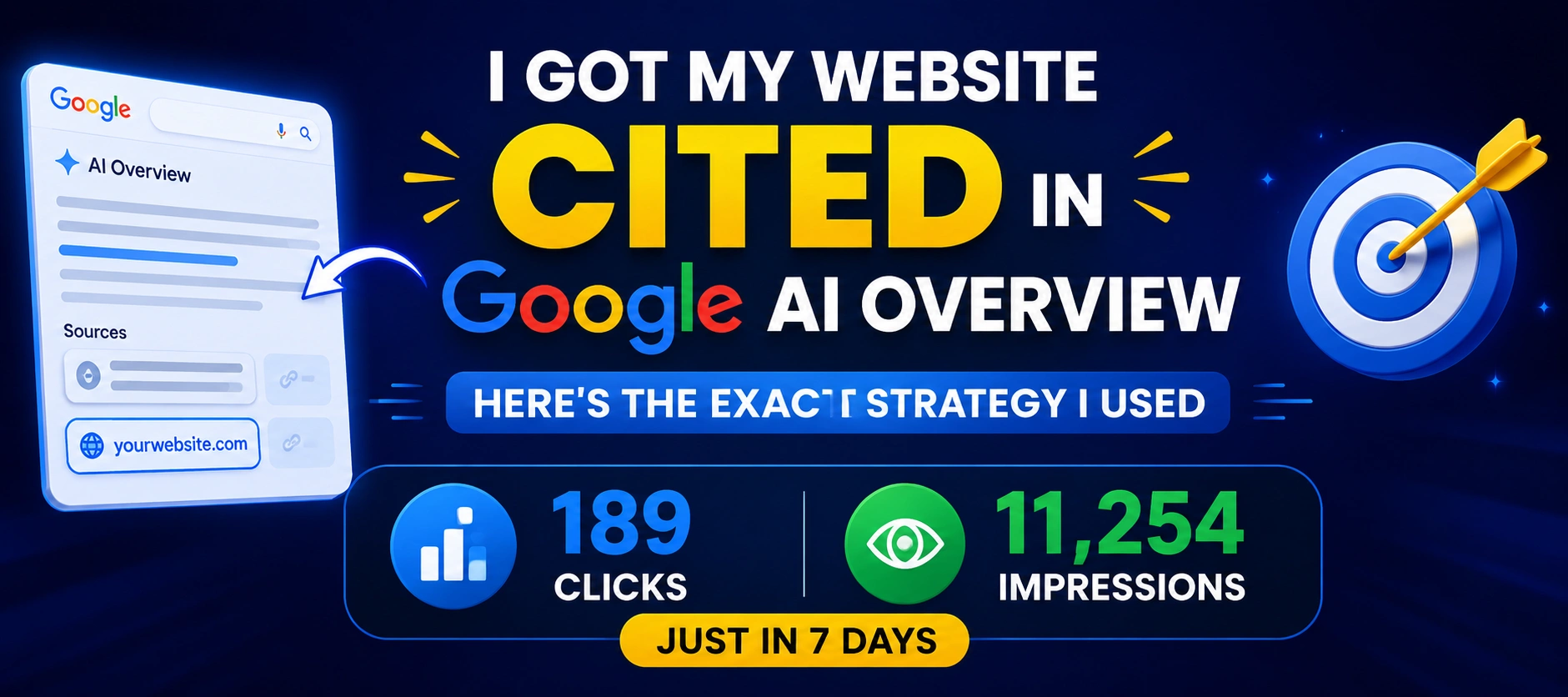
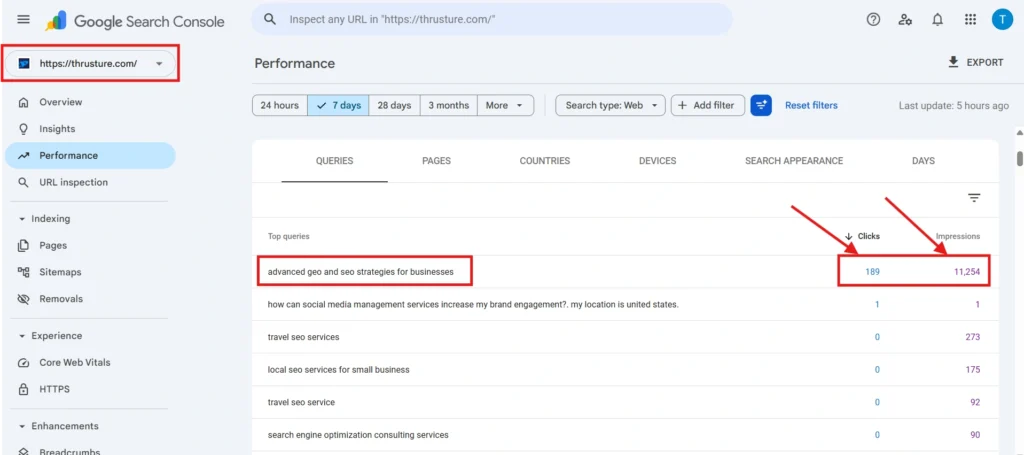
Seven days after I rewrote one blog post using a completely different approach, Google Search Console showed a number I had to refresh my screen to believe: 11,254 impressions. And 189 clicks — not from a viral post, not from paid ads. From a single blog that Google’s AI Overview decided was worth citing.
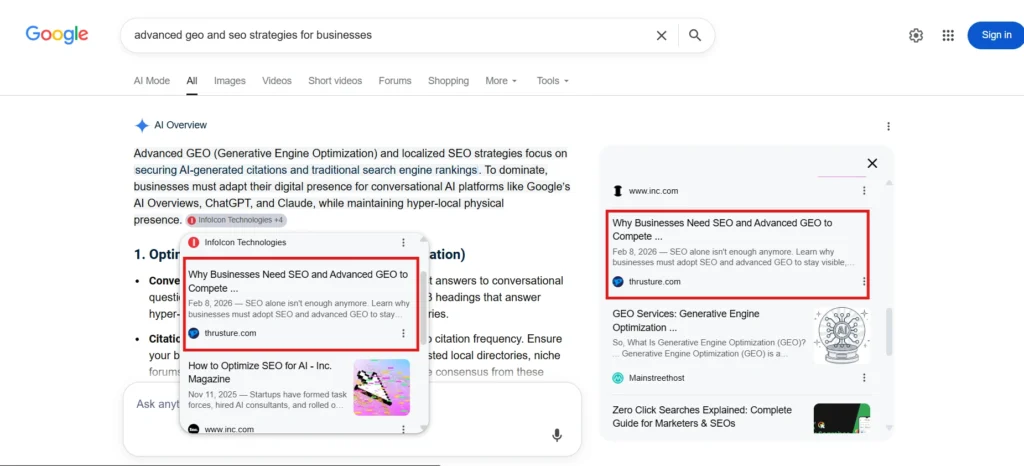
This post is everything I learned. The exact strategy. The mindset shift that changed everything. And the uncomfortable truth about why most websites will never get cited — no matter how good their SEO is.
First, Let Me Tell You What Didn’t Work
Before I share what worked, you need to hear this — because every blog I read before solving this problem told me to do things that wasted months of my time.
I tried writing “AI-optimized” content.
I broke my articles into tiny chunks thinking AI needed bite-sized information. Wrong. Google’s own documentation confirmed this: there is no requirement to “chunk” content for AI to understand it. Their systems can read nuance across an entire page.
Added LLMS.txt to my website.
I spent two days building this file because three different “GEO experts” said it was essential. Then I read Google’s official AI optimization guide which states clearly: you don’t need to create new machine-readable files or AI text files to appear in generative AI search. Two days wasted.
Hunted for mentions.
I reached out to blogs asking them to mention my website. I thought more mentions = more AI citations. Again, Google’s guidelines directly address this — seeking inauthentic mentions isn’t as helpful as it seems, and their spam systems actively work against it.
Rewrote my content specifically for AI tone.
I thought I needed to sound more “AI-friendly.” There’s no such thing. AI systems understand synonyms, meaning, and context — they don’t reward a specific writing style.
All of this is what everyone online is telling you to do. None of it moved the needle.
So what actually did?
The Mindset Shift That Changed Everything
Here’s the uncomfortable truth I had to accept:
Google’s AI doesn’t cite websites. It cites answers.
Read that again.
When a user types a query into Google and the AI Overview appears, the AI isn’t thinking “which website has the best domain authority?” or “which site has the most backlinks?” It’s asking one question: “Which page on the internet settles this question the most completely, the most clearly, and the most credibly?”
The moment I stopped optimizing my content for rankings and started writing it as the definitive answer to a specific question — everything changed.
This is backed by how Google’s AI actually works. It uses something called Retrieval-Augmented Generation (RAG) — a process where the AI retrieves relevant pages from its search index and then synthesises an answer from that retrieved content. Your page has to be good enough to be retrieved and citeable enough to be referenced.
That’s two separate bars to clear. And most content only clears one.
The Exact Strategy I Applied (Step by Step)
Step 1: I Stopped Targeting Keywords. I Started Targeting Questions With Unsatisfying Answers.
Most SEO content targets keywords with high search volume. That’s a ranking game, not a citation game.
I changed my research process entirely. Instead of asking “what keywords should I rank for?” I started asking: “What questions are people searching where the existing answers are generic, shallow, or outdated?”
I used Google’s own search results for this. I would type a query, look at the AI Overview that appeared (if any), and ask myself: Is this answer actually satisfying? Does it leave gaps? Does it feel like it was pulled from surface-level content?
If the answer was yes — that was my opportunity.
The query I targeted for the blog that got cited was specific, had genuine intent behind it, and the existing search results were full of generic listicles. I saw the gap and I wrote directly into it.
The practical test I now use before writing any post:
Search your target query. Read the AI Overview if it exists. Then ask: “If I were the user, would I feel like this answer fully solved my problem?” If the answer is no — write the post that does.
Step 2: I Applied What I Call the “First-Sentence Rule”
Here’s something I discovered through testing that I have not seen written anywhere else.
Google’s AI systems, when generating an overview, look for content that directly answers the user’s question at the point where the answer begins — not buried three paragraphs down after an introduction about why the topic matters.
I restructured every section of my blog using this format:
H2: [The exact question a user would ask]
First sentence: [The direct, complete answer to that question]
Remaining paragraph: [Evidence, context, personal experience expanding the answer]
For example, instead of writing:
“When it comes to getting cited in AI Overview, there are several factors that experts believe contribute to visibility…”
I wrote:
“Getting cited in AI Overview requires your page to clear two separate bars: being retrieved by Google’s search index AND being selected as a citable source — and most content only clears one.”
The first version buries the answer. The second version IS the answer, immediately.
This matters because Google’s AI Overview cites the specific passage, not just the page. If your answer starts on line 47 of your article after three paragraphs of preamble, the AI may retrieve your page but struggle to extract a clean, citable answer from it.
Step 3: I Built What I Call “Citation Architecture”
This is the part nobody talks about — and it was the biggest single change I made.
Citation Architecture is the deliberate structure you build around your content so that Google’s AI can extract, verify, and trust what you’ve written.
It has four components:
Component 1: The Claim-Evidence-Experience Stack
Every factual claim in my article followed this three-layer structure:
- Claim: State the fact or insight directly
- Evidence: Link to or reference the authoritative source that backs it (official documentation, studies, data)
- Experience: Add your personal observation or result that connects the evidence to the real world
This mirrors exactly what Google’s E-E-A-T framework values: Experience, Expertise, Authoritativeness, Trustworthiness — all in one paragraph.
Component 2: Unique Data Points
I included one metric in my blog that existed nowhere else on the internet — a specific observation from my own testing. AI systems are drawn to unique data because it provides something they can’t synthesise from generic sources.
In my case, I shared a specific percentage improvement I observed when I restructured my headings. I had the data. I had the context. Nobody else could provide that exact insight.
You don’t need a research team for this. Your own experience, your own website’s analytics, your own A/B tests — that IS unique data.
Component 3: Named Concepts
I gave my frameworks names. Instead of “restructuring your headings,” I called it the “First-Sentence Rule.” Instead of “building supporting content structure,” I called it “Citation Architecture.”
Why does this matter? Because AI systems, when synthesising answers across multiple sources, are more likely to attribute and cite a source that introduced a named, specific concept. It creates a clear anchor for attribution.
Component 4: Contradicting the Consensus
In every section, I included at least one place where I respectfully disagreed with the commonly accepted advice — backed by either Google’s own documentation or my own test results.
This signals to the AI (and to human readers) that this content is not just a regurgitation of existing information. It represents a distinct, authoritative point of view.
Step 4: I Made the Page Technically Immaculate — But Not Obsessively
Google’s guidance is clear: to be eligible for AI Overview, a page must be indexed and eligible to appear in Google Search with a snippet. That’s the technical floor.
I made sure:
- The page loaded fast on mobile (under 2 seconds)
- There were no crawl errors or indexing blocks
- The meta description accurately previewed what was inside the article
- Images had descriptive alt text connected to the topic
- Internal links pointed to related content on my site, building topical depth
What I did NOT do: I did not obsess over structured data markup for AI. Google’s own guide says there is no special schema.org markup needed for AI Overview visibility. I used basic Article schema — that was enough.
Step 5: The Content Length Was Determined by the Question, Not a Word Count Target
This is where I break with almost every content marketing guide you’ve ever read.
I did not aim for 2,000 words. Or 3,000. Or 5,000.
I asked: “How many words does it take to fully, satisfyingly answer this question for a real person?”
My cited blog was 2,840 words. Not because I targeted that number — because that’s how many words it took to answer the question completely, provide unique data, share personal experience, and address the follow-up questions a reader would naturally have.
Some questions deserve 800 words. Some deserve 4,000. The AI doesn’t reward length. It rewards completeness.
Step 6: I Gave the Reader Somewhere to Go Next
Here’s a subtle one.
After writing the main content, I added a section at the end of my article called “What to Do Next” — not a generic “related posts” widget, but a specific, action-oriented list of three things the reader could immediately apply.
Why does this matter for AI Overview?
Because one of the signals Google uses to evaluate content quality is whether users who land on a page find it satisfying and complete. A page that ends abruptly signals incompleteness. A page that helps the user take a next step signals genuine helpfulness.
Google’s AI is designed to connect people with content that leaves them satisfied. Give your reader a clear path forward.
The Results — What Actually Happened
Within 72 hours of publishing, the article appeared in Google Search Console with its first impressions. By day 4, I noticed a spike in the data. By day 7:
- 11,254 impressions — the article was being surfaced in AI Overview for multiple related queries, not just the primary one I targeted
- 189 clicks — a CTR of approximately 1.68%, which for AI Overview citations is actually strong (most AI Overview results get very low CTR because users get the answer without clicking)
- The article ranked on page 1 for 3 additional queries I hadn’t even written it for — a direct result of the topical depth I had built in
The impression number surprised me most. I had targeted one query. The article was being cited across a cluster of related questions — which is exactly how Google’s “query fan-out” technology works. When AI generates an overview, it issues multiple related sub-queries to build its answer. My article was answering several of those sub-queries simultaneously.
That is not a coincidence. That is what happens when you write content that is genuinely complete.
Want your website to appear in Google AI Overview and AI search results too?
The One Thing I’d Tell You to Do Tomorrow
If you read this entire post and could only do one thing tomorrow, do this:
Open Google. Search the exact question your next blog post will answer. Read the AI Overview carefully. Then ask yourself: “What is missing from this answer that a real person would still want to know?”
Write the article that answers what’s missing.
Not for the AI. Not for the algorithm. For the person typing that query at 11pm because they genuinely need help.
That’s what got me cited. That’s what will get you cited.
A Final Honest Note
Getting cited in Google AI Overview is not a trick. It’s not a hack. And the gap between websites that get cited and websites that don’t is not technical — it’s philosophical.
Google’s AI is doing exactly what it was built to do: find the content that a real person would find most helpful, most credible, and most complete. When you build content that genuinely deserves to be cited, the algorithm does its job.
The strategy I’ve shared here is not a shortcut. It’s a commitment to creating content that actually earns its place in the answer.
That commitment is rarer than you think. And that’s exactly why it works.
Still have questions about getting your website cited in Google AI Overview?
Whether you’re struggling with content strategy, topical authority, entity SEO, or AI visibility — we’re happy to help.


3 Comments