The Problem Every Business Owner Is Starting to Notice
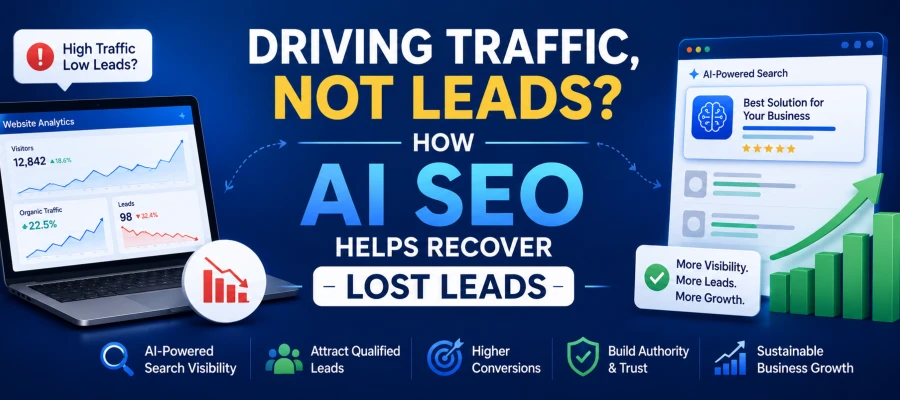
“My Rankings Haven’t Dropped… So Why Are My Leads?”
A few months ago, I was speaking with the owner of a growing software company. Frustrated, he asked me a question I’ve been hearing more frequently over the past year:
“Our website still ranks on the first page of Google for most of our important keywords, but the number of enquiries has dropped significantly. What are we doing wrong?”
At first glance, his concern didn’t make sense. We reviewed his website together, and technically, everything looked healthy. His rankings were stable, his pages were well-optimized, and there were no major SEO issues.
Yet the numbers told a different story. Organic traffic had started to decline, click-through rates were lower than before, and most importantly, the website was generating fewer qualified leads.
If you’re experiencing something similar, you’re not alone.
Over my 15+ years in SEO, I’ve witnessed countless changes in Google’s algorithms. From Panda and Penguin to Mobile-First Indexing and Core Web Vitals, every update forced businesses to adapt.
But what we’re seeing today isn’t just another update. It’s a complete transformation in how people search for information online. And if businesses don’t understand this shift, they risk losing visibility, traffic, and ultimately, valuable business opportunities.
The Search Landscape Has Quietly Changed
For years, SEO followed a predictable pattern.
A potential customer searched for a product or service, Google displayed a list of websites, and users clicked through the results to find the information they needed.
The objective was simple:
- Rank higher.
- Get more clicks.
- Generate more traffic.
- Convert visitors into customers.
It was a model that worked remarkably well for businesses willing to invest in quality SEO.
Today, however, search is no longer just about finding websites. It’s about getting answers instantly. When someone searches for a business-related question now, Google often displays AI-generated summaries, featured snippets, product comparisons, maps, videos, reviews, and knowledge panels before traditional website listings.
Similarly, platforms like ChatGPT, Gemini, Microsoft Copilot, and Perplexity AI provide detailed answers by combining information from multiple trusted sources.
Instead of encouraging users to visit ten different websites, AI is helping them make informed decisions much faster. While this creates a better experience for users, it introduces a new challenge for businesses. If customers receive the answers they need without clicking through to your website, where do your leads come from?
The New Reality: Rankings Alone Don’t Drive Business Growth
One of the biggest misconceptions in digital marketing is that ranking first on Google automatically guarantees business success. That assumption may have been true several years ago.
Today, it deserves to be challenged.
Imagine you’re searching for the “best CRM software for small businesses.”
Instead of showing ten blue links and asking you to compare each option yourself, Google now provides an AI-generated overview that summarizes key features, compares leading solutions, and even suggests which option may be most suitable for different business needs.
Many users find the information they need without ever clicking a website.
Now think about your own business. Even if your website appears in the top search results, your potential customers may never reach it if AI has already answered their questions. This is one of the biggest reasons businesses are experiencing declining organic traffic despite maintaining strong keyword rankings. The issue isn’t that SEO has stopped working. The issue is that the customer journey has fundamentally changed.
Why Business Owners Should Be Concerned
When I speak with business owners, very few of them tell me they care about rankings. What they care about is business growth.
They want:
- More qualified enquiries.
- Better-quality leads.
- Higher conversion rates.
- Sustainable growth.
- A stronger return on their marketing investment.
Rankings are simply a means to achieve those outcomes.
If rankings no longer produce the same level of visibility, then businesses need to rethink how success is measured.
- Instead of asking: “Are we ranking first?”
- Business owners should begin asking: “Are potential customers discovering and trusting our business before they contact us?”
This subtle shift in thinking changes everything. The businesses that thrive over the next few years won’t necessarily be those with the most keywords ranking on Google. They’ll be the businesses that consistently establish themselves as trusted authorities, both for people and for AI-powered search platforms.
Do you want to drive quality and qualified leads and boost business performance?
The Rise of Zero-Click Search
One of the biggest contributors to declining organic traffic is a phenomenon known as zero-click search.
Simply put, a zero-click search occurs when users find the information they need directly on the search results page without visiting any website.
This happens through:
- AI-generated answers
- Featured snippets
- Knowledge panels
- Maps
- Product comparisons
- People Also Ask sections
- Instant definitions
For users, this saves time.
For businesses, it creates a new competitive challenge. The competition is no longer just about appearing on the first page of Google. It’s about becoming the trusted source behind the answer. That requires a different approach to SEO, one that focuses on authority, expertise, and trust rather than rankings alone.
From My Experience
Throughout my career, I’ve seen businesses celebrate achieving the number one position on Google, believing their work was complete. But rankings have never been the final destination, they’ve always been a stepping stone.
Today, that distinction matters more than ever. In the age of AI-powered search, visibility isn’t measured by where your website appears on a results page. It’s measured by whether your business is trusted enough to become part of the answer.
And businesses that recognize this shift early will have a significant competitive advantage.
How Businesses Can Adapt and Win in the AI Search Era
We explored why many businesses are seeing a decline in organic leads even though their Google rankings haven’t changed significantly. The reality is that search behavior has evolved. AI-powered search experiences are changing how people discover information, compare businesses, and make buying decisions.
The good news is that this shift isn’t the end of SEO. It’s the beginning of a smarter, more business-focused approach.
Businesses that adapt today won’t just recover lost visibility, they’ll position themselves as trusted authorities in an AI-driven digital landscape.
- The question is no longer: “How do I rank #1 on Google?”
- The better question is: “How do I become the business that AI confidently recommends?”
That’s exactly where AI SEO services for business growth comes into the picture.
What AI Looks for Before Recommending Your Business
One of the biggest misconceptions surrounding AI search is that it works exactly like traditional search engines.
It doesn’t.
Instead of simply matching keywords, AI attempts to understand context, credibility, expertise, and user intent before generating an answer. Think about how you choose a business in real life. You don’t select a company just because it has the biggest signboard.
You evaluate factors like:
- Does this company appear knowledgeable?
- Do they have real experience?
- Are they trusted by others?
- Do they consistently provide valuable information?
- Would I feel confident doing business with them?
AI evaluates businesses in a surprisingly similar way.
While the exact algorithms remain proprietary, it’s becoming increasingly clear that AI platforms favor businesses that demonstrate:
- Genuine expertise
- Consistent topical authority
- Helpful and original content
- Strong brand credibility
- Positive user signals
- Trustworthy digital presence
In other words, AI isn’t just indexing websites. It’s evaluating reputation.
That means businesses can no longer rely on publishing occasional blog posts filled with keywords. They need to build a comprehensive knowledge base that consistently answers customer questions and demonstrates expertise.
Ready to optimize your business for AI search?
Five Practical Ways to Recover Lost Organic Leads for Your Business
The shift toward AI search may seem overwhelming, but the solution doesn’t require starting from scratch. Here are five practical strategies I recommend to businesses looking to improve their visibility and generate more qualified leads.
1. Focus on Solving Problems, Not Chasing Keywords
Traditional SEO often encourages businesses to target high-volume keywords.
AI search rewards businesses that solve real problems.
- Instead of asking: “What keyword should I rank for?”
- Ask: “What challenges are my customers trying to solve?”
For example, a digital marketing agency shouldn’t only publish content about “SEO Services.”
It should also answer questions such as:
- Why is my website traffic declining?
- Why aren’t my Google rankings generating leads?
- How can AI improve my digital marketing strategy?
- Is SEO still worth investing in?
When your content addresses genuine business concerns, it becomes far more valuable to both readers and AI systems.
2. Build Topical Authority Instead of Publishing Random Content
One well-written blog isn’t enough anymore. Businesses need to demonstrate depth of expertise. This is why I strongly believe in creating content clusters around important business topics.
For example, rather than publishing isolated articles, create an interconnected knowledge hub around AI SEO:
- AI SEO for Business Growth (Pillar)
- Why Google Rankings Are No Longer Generating Leads
- How to Build an AI SEO Strategy
- Google AI Overviews Explained
- Zero-Click Search and Business Growth
Each article strengthens the others, making it easier for search engines, and AI, to recognize your expertise. More importantly, it creates a better experience for readers who want to explore a topic in greater depth.
3. Share Real Experience, Not Generic Advice
Artificial intelligence has made it incredibly easy to generate content. Unfortunately, that also means the internet is becoming flooded with articles that all say the same thing.
One thing AI cannot replicate is your personal experience.
Share:
- Lessons you’ve learned from client projects.
- Mistakes you’ve seen businesses make.
- Practical recommendations based on real-world outcomes.
- Industry observations from years of experience.
These insights not only build credibility with readers but also align with Google’s emphasis on Experience, Expertise, Authoritativeness, and Trustworthiness (E-E-A-T).
4. Strengthen Your Brand Beyond Your Website
Many businesses think SEO begins and ends on their website. In reality, your brand is shaped across the entire digital ecosystem.
Your authority grows when you actively contribute through:
- LinkedIn thought leadership
- Guest articles
- Industry webinars
- Podcasts
- Case studies
- Customer testimonials
- Professional communities
Every mention of your brand reinforces your credibility. The stronger your digital footprint becomes, the easier it is for AI systems to recognize your business as a trusted source of information.
5. Continuously Improve Your Best Content
Publishing an article isn’t the finish line. It’s the starting point. The businesses that consistently outperform competitors treat their content as a living resource.
Regularly update your cornerstone articles by adding:
- New industry insights
- Fresh examples
- Better visuals
- Additional FAQs
- Internal links
- Updated screenshots
- Customer success stories
Content that evolves with your audience remains relevant for much longer than content that’s published once and forgotten.
From My Experience
One of the biggest mistakes I’ve seen businesses make over the years is treating SEO like a one-time project. They invest in optimization, publish a handful of articles, achieve good rankings, and assume the work is complete.
The reality is quite different.
Search has always rewarded businesses that continue learning, improving, and providing value. AI search simply raises the standard.
The businesses that will succeed over the next decade won’t necessarily be those with the largest marketing budgets. They’ll be the ones that consistently educate their audience, solve meaningful problems, and build genuine trust over time.
That’s encouraging because trust isn’t something you can buy, it’s something you earn.
Final Thoughts
The world of search is changing faster than ever before. For businesses, this can feel unsettling. But every major shift in digital marketing creates new opportunities for those willing to adapt. The companies that continue measuring success solely by rankings may struggle to understand why enquiries are slowing down. The companies that focus on building trust, demonstrating expertise, and solving customer problems will continue to thrive, regardless of how search technology evolves.
Over the past 15 years, I’ve learned that sustainable SEO has never been about finding shortcuts. It’s about understanding your audience, creating meaningful content, and earning credibility over time. That philosophy hasn’t changed. What has changed is the way customers discover businesses.
Instead of asking, “How do I rank higher?”, start asking: “How do I become the business my customers, and AI, trust enough to recommend?”
The businesses that answer that question today won’t just recover lost organic leads. They’ll build a stronger, more resilient digital presence that’s prepared for the future of search.
Ready to Future-Proof Your Business?
If your website is still relying solely on traditional SEO, now is the time to evolve your strategy.
At Thrusture, we help businesses bridge the gap between traditional SEO and AI-powered search by creating strategies that improve visibility, build authority, and generate qualified leads.
Because in today’s search landscape, success isn’t just about being found. It’s about being trusted.