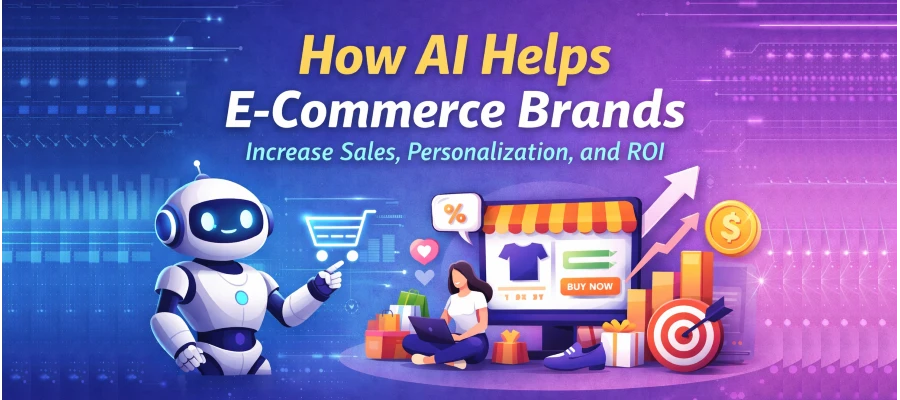
E-commerce brands today operate in a highly competitive landscape where standing out means delivering exceptional value instantly. Brands face rising customer expectations for seamless, tailored experiences, skyrocketing ad costs, fierce competition from giants like Amazon, and persistent issues like high cart abandonment rates (often 70%+). Supply chain disruptions, inventory mismatches, and inefficient customer support further strain margins.
Why is AI Becoming Essential for E-Commerce Growth?
Traditional methods of static product listings, broad email blasts, and rule-based automation are no longer sufficient. They treat every shopper the same, leading to generic interactions that fail to convert or retain. Shoppers now demand relevance: 78% prefer personalized experiences, and those who get them are far more likely to buy repeatedly.
AI solves these real business problems by analyzing vast data in real-time to predict needs, automate decisions, and optimize every touchpoint. From boosting e-commerce sales and conversions by 10-15% on average (with some seeing up to 25%) to driving revenue lifts of 20-40% through smart personalization, AI turns data into actionable growth. In 2025-2026, brands ignoring AI risk falling behind as the AI-enabled e-commerce market surges toward billions in value.
What AI Means for E-Commerce?
What Is Artificial Intelligence in E-Commerce?
AI in e-commerce refers to smart software that learns from data to make decisions or suggestions without constant human input. It powers things like recommending products you’ll love, chatting like a helpful salesperson, or adjusting prices based on what’s happening right now. At its heart, AI uses machine learning (patterns from past behavior) and sometimes generative capabilities to create or refine content.
How AI Is Different from Basic Automation
Basic automation follows fixed rules: “If the cart is abandoned, send a reminder email after 1 hour.” It’s helpful but rigid and doesn’t adapt. AI goes further, it learns and improves. It spots patterns humans miss, like subtle browsing signals predicting intent, then personalizes dynamically. Where automation repeats tasks, AI anticipates, predicts, and evolves, turning one-size-fits-all into truly individual experiences.
Where E-Commerce Brands Lose Sales Without AI?
Poor Personalization and Generic Offers
Without AI, offers feel impersonal, everyone sees the same homepage or promo. This leads to disengagement, as 61% of executives say personalization drives growth, yet many brands still send blanket messages.
Low Conversion Rates
Average e-commerce conversion hovers around 1.65-3%, but without smart tools, visitors bounce quickly. Generic search or navigation frustrates, missing chances to guide buyers.
High Cart Abandonment
70%+ carts are abandoned due to doubts, high shipping, or lack of trust. No real-time nudges or personalized incentives mean lost revenue.
Inefficient Marketing Spend
Ads waste money on broad targeting. Without predictive insights, brands overspend on uninterested audiences, inflating acquisition costs.
These pain points compound, lower trust, fewer repeats, stagnant growth—until AI steps in to flip the script.
How AI Increases E-Commerce Sales?
AI-Powered Product Recommendations
AI analyzes browsing, purchases, and even real-time behavior to show relevant items. “Right product at the right time” boosts discovery and impulse buys.
Cross-sell/upsell shines: “Frequently bought together” or “Complete the look” suggestions increase average order value (AOV) by 10-50%. Amazon’s engine reportedly drives 35% of sales this way.
AI for Smarter Search and Navigation
Traditional keyword search misses intent; AI understands synonyms, visuals, or context (“summer dress for beach wedding”). Faster, accurate results speed decisions and lift conversions, sometimes 3x when search is used.
Dynamic Pricing and Offer Optimization
AI adjusts prices based on demand, competitor moves, inventory, and user signals. Real-time tweaks maximize revenue without alienating buyers, often adding 25%+ to profits in optimized scenarios.
How AI Improves Personalization Across the Customer Journey?
Personalized Homepages and Product Pages
AI customizes layouts: returning visitors see favorites first, new ones get trending matches based on location or demographics. This creates “welcome home” feelings, boosting engagement.
AI-Driven Email and SMS Personalization
Beyond basic segmentation, AI crafts subject lines, content, and timing per user. Abandoned cart flows recover 20-42% more with tailored nudges.
Personalized Ads and Retargeting Campaigns
AI targets lookalikes, predicts churn, and serves dynamic creatives. Retargeting becomes hyper-relevant, cutting wasted spend and lifting ROI.
Focus on experience: shoppers feel understood, not sold to, fostering loyalty.
How AI Helps Improve Marketing ROI?
Better Audience Targeting
AI segments deeply using behavior, not just demographics, hitting high-value prospects precisely.
Predictive Customer Behavior Analysis
Forecasts purchases, churn, or lifetime value to prioritize efforts.
Reduced Wasted Ad Spend
AI optimizes bids, placements, and creatives in real-time—Google AI campaigns often see 10-17% higher ROAS.
Improved Conversion Tracking
Multi-touch attribution reveals true channel impact for smarter budgeting.
Practical AI Use Cases for E-Commerce Brands
AI in Paid Advertising and Performance Marketing
Tools like Google Performance Max or Demand Gen use AI for auto-optimization, delivering 8-17% better ROAS than manual setups.
AI in SEO and Content Optimization
AI suggests keywords, generates meta descriptions, or personalizes content for better rankings and engagement which helps in fastening up the SEO for your business.
AI in Customer Support (Chatbots & Automation)
Chatbots handle queries 24/7, deflect tickets, and recommend products, boosting satisfaction and sales.
AI in Inventory and Demand Forecasting
Predicts stock needs accurately, reducing overstock/understock by 20-40%.
Benefits of Using AI for E-Commerce Businesses
Higher Sales and Conversion Rates
Personalization lifts revenue 10-41%, conversions 10-25%.
Better Customer Experience
Relevant, fast interactions build delight—78% prefer personalized brands.
Increased Customer Retention
Tailored experiences encourage repeats; returning AI-assisted buyers spend 25% more.
Smarter, Data-Driven Decisions
Insights replace guesswork for efficient scaling.
Is AI Suitable for Small and Mid-Sized E-Commerce Brands?
Common Myths About AI in E-Commerce
Myth 1: “AI is only for big players like Amazon.” Reality: Tools like Shopify apps or affordable platforms make it accessible.
Myth 2 : “It’s too expensive/complex.” Many offer plug-and-play with low entry costs.
How Small Businesses Can Start with AI
Begin with one use case, like recommendations via Nosto or Gorgias chatbots.
Budget-Friendly AI Adoption Tips
Use Shopify/WordPress integrations, free tiers (e.g., Google Analytics AI), or scalable SaaS. Start small, measure ROI, then expand—many see quick wins like 10-30% sales lifts.
Challenges of Using AI in E-Commerce (and How to Overcome Them)
Data Quality and Integration Issues
Poor data leads to bad results. Overcome: Clean data first, use unified platforms.
Cost and Implementation Concerns
High upfront fears. Solution: Start with low-cost tools, pilot, focus on high-ROI areas.
Choosing the Right AI Tools
Overwhelm from options. Evaluate based on integration, ease, case studies, and support.
Real-World Examples of AI in E-Commerce
Example: Increasing Sales with AI Recommendations
Amazon’s recommendation engine drives ~35% of sales by suggesting relevant items based on behavior. Smaller brands like Stitch Fix use AI styling to boost repeat purchases 40% and AOV 10%.
Yves Rocher saw 11x higher purchase rates with AI recommendations vs. top-seller lists.
Example: Improving ROI with AI-Powered Ads
Google AI tools (Performance Max, Broad Match) deliver 8-17% higher ROAS. A mid-sized e-com brand using AI segmentation saw +30% sales, +50% engagement in months.
Bloomreach clients achieved 251% ROI with AI marketing automation.
Example: Enhancing Customer Experience Using AI Chatbots
TFG integrated an AI chatbot, gaining 35.2% higher conversions, 39.8% revenue per visit rise during peaks.
Sephora’s Virtual Artist and chatbots provide personalized beauty advice, boosting engagement.
Future of AI in E-Commerce
Hyper-Personalized Shopping Experiences
AI will create fully custom journeys, predicting needs before searches.
AI-Driven Predictive Commerce
Anticipate purchases, auto-reorder, or proactive offers.
Voice and Visual Search
Shop via photos/voice for frictionless discovery.
How to Get Started with AI in Your E-Commerce Business?
Step 1: Identify Business Goals
Pinpoint pain points low conversions? High abandonment? Start there.
Step 2: Choose the Right AI Use Cases
Prioritize high-impact: recommendations, chatbots, or ads.
Step 3: Start Small and Scale Gradually
Test one tool, measure (e.g., A/B tests), optimize, then expand. Partner with platforms like Shopify for easy integration.
Final Thoughts: Why AI Is a Growth Partner for E-Commerce Brands
AI isn’t a buzzword, it’s a proven partner turning challenges into opportunities. With measurable lifts in sales, personalization that delights, and ROI that justifies investment, brands adopt AI position for sustainable growth in a competitive world. Start today: audit your gaps, pick a focused use case, and watch data work for you. The future belongs to those who personalize intelligently and make AI your edge.